
Affiliate disclosure: this article contains paid links. As an Amazon Associate I earn from qualifying purchases.
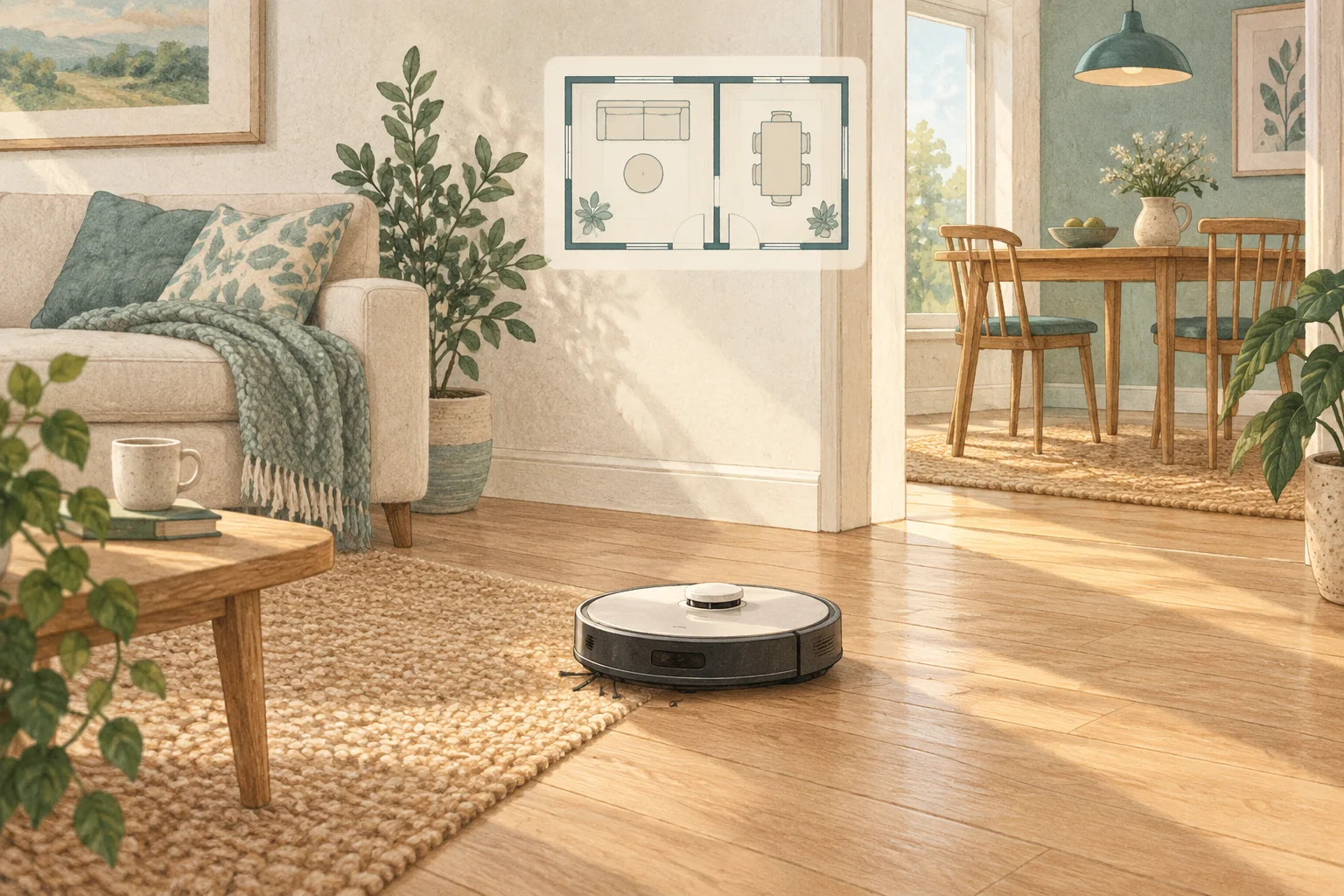
A saved room is convenient for repeat jobs, while a temporary zone is useful for a local patch of suitable debris. The best choice depends on how stable the target area is.
Table of Contents
A practical checklist
- Use room routines for repeatable spaces such as a kitchen.
- Use a zone for a small dry area that does not need a permanent map edit.
- Check access and no-go boundaries before sending the robot to either.
What this looks like at home
Crumbs beside a breakfast table may need a small zone rather than the entire open-plan living area.
Give the robot a consistent starting point
| Check | What matters |
|---|---|
| Starting point | Use the model’s recommended localisation procedure. |
| Selected map | Confirm the correct floor and room selection. |
| Physical route | Check doors, furniture and the return to the dock. |
A mistake to avoid
A zone command does not make wet spills or sharp debris suitable for the robot.
Relevant models to compare
Eufy L60
A simple mapped vacuum for households that already mop by hand.
Check Eufy L60 on Amazon UK. Confirm the selected UK variant, seller, contents and current price.
Roborock QV35S
An automatic mop-care system with app-adjustable routines and structured-light obstacle detection.
Check Roborock QV35S on Amazon UK. Confirm the selected UK variant, seller, contents and current price.
Related guidance
- How to Map Your Home for a Robot Vacuum: A 2026 Guide
- Robot Vacuum Maintenance Tips UK: Keep Your Cleaner Running Smoothly
Sources and scope
Checked on 9 September 2026. Manufacturer instructions apply to the models they name; use your own exact manual for button sequences, removable parts and cleaning permissions. Product specifications are advertised claims. Examples illustrate decisions and are not hands-on test results.