
Table of Contents
As an Amazon Associate, we earn from qualifying purchases. This means we may receive a small commission at no extra cost to you when you buy through links on this page.
Introduction: Why a Robot Vacuum for Carpets?
Carpets, while adding warmth and comfort to our homes, are notorious for trapping dust, dirt, and pet dander. Traditional vacuuming can be a chore, eating into your valuable time. Enter the robot vacuum – a game-changer for effortless floor cleaning. In 2026, robot vacuum technology has advanced significantly, offering powerful suction, intelligent navigation, and features specifically designed to tackle carpets effectively. They aren’t just for hard floors anymore! Advancements in brushroll design and carpet boost modes have dramatically improved their performance on various carpet types. A robot vacuum provides consistent, automated cleaning, keeping your carpets fresher for longer and saving you precious hours.
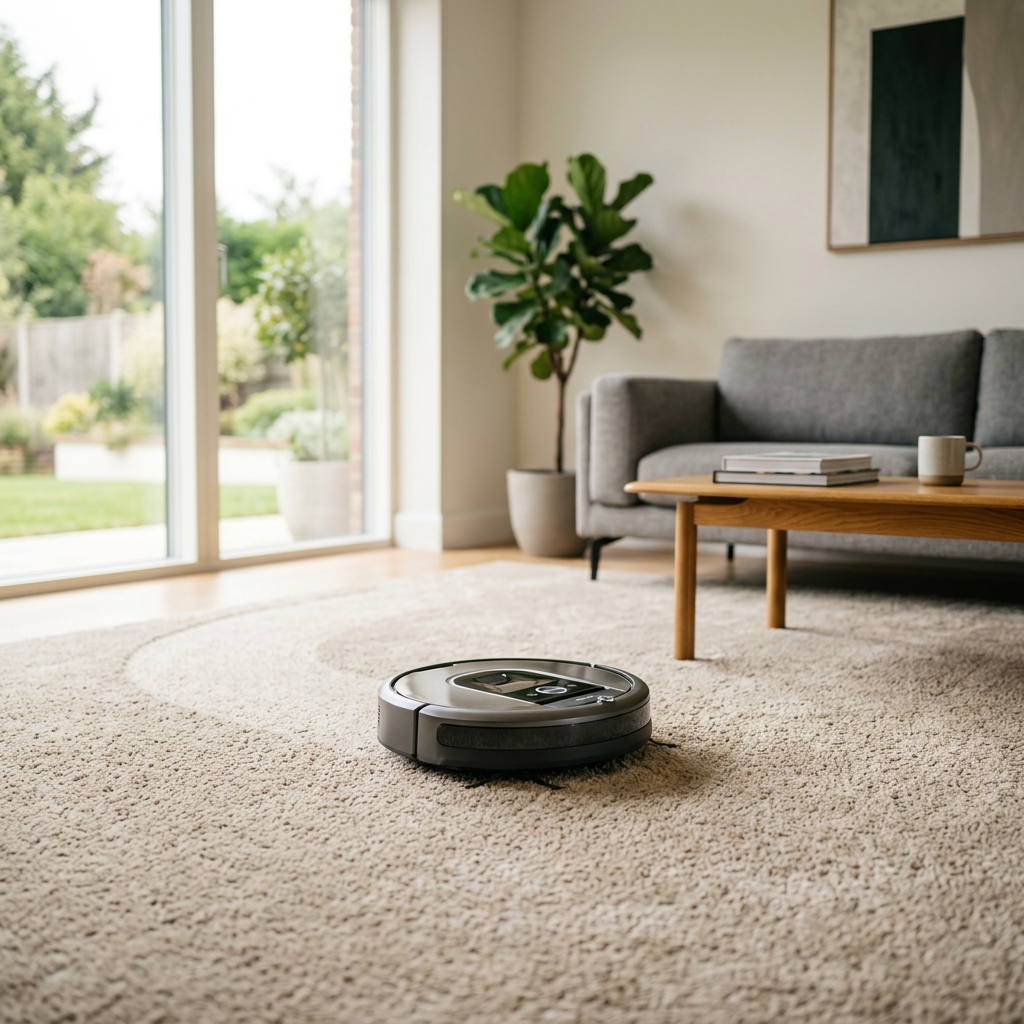
Understanding Carpet Types & Robot Vacuum Compatibility
Not all carpets are created equal, and choosing a robot vacuum requires understanding your carpet’s characteristics. Key factors include:
- Pile Height: Low-pile carpets are easier to clean than high-pile (shag) carpets. Higher pile requires stronger suction and potentially a more aggressive brushroll.
- Fibre Type: Wool carpets are delicate and require gentle brushrolls to avoid damage. Synthetic carpets (nylon, polyester, polypropylene) are more durable and can withstand more powerful cleaning.
- Carpet Density: Densely woven carpets trap more dirt but are typically easier for vacuums to navigate.
For low-pile synthetic carpets, most robot vacuums will perform well. However, for high-pile or wool carpets, look for models with adjustable suction, specialised brushrolls (soft rubber or with adjustable bristles), and ‘carpet boost’ modes. Avoid overly aggressive brushrolls that could snag delicate fibres.
Key Features to Look for in a Carpet Robot Vacuum
When selecting a robot vacuum for carpets, consider these crucial features:
- Suction Power (Pa): Measured in Pascals (Pa), higher suction power is essential for lifting dirt and debris from carpets, especially thicker piles. Aim for at least 2000Pa, with 3000Pa+ recommended for deep cleaning.
- Brushroll Design: Multi-surface brushrolls are versatile, but tangle-free brushrolls are vital for pet owners, preventing hair from wrapping around the brush. Some models offer interchangeable brushrolls for different floor types.
- Filtration: HEPA filters capture allergens and fine dust particles, improving air quality, particularly important for allergy sufferers.
- Navigation: LiDAR (Light Detection and Ranging) and vSLAM (Visual Simultaneous Localization and Mapping) are advanced navigation technologies that create accurate maps of your home, enabling efficient cleaning patterns and obstacle avoidance.
- Smart Mapping: Allows you to define no-go zones, virtual walls and specific cleaning areas within the app.
- App Control: Enables remote control, scheduling, monitoring cleaning progress, and adjusting settings.
- Battery Life: Longer battery life is essential for larger homes. Consider models with automatic recharging and resume cleaning capabilities.
- Auto-Empty Base Compatibility: An auto-empty base automatically empties the dustbin, reducing maintenance frequency.
- Carpet Boost Mode: Increases suction power specifically when cleaning carpets for a deeper clean.
Top 5 Robot Vacuums for Carpets – 2026 Reviews
1. iRobot Roomba j7+ (with Clean Base)
The Roomba j7+ remains a top contender in 2026. Its PrecisionVision Navigation excels at avoiding obstacles (including pet waste!), and its powerful suction tackles most carpet types effectively. The Clean Base provides automatic dirt disposal for months of hands-free operation.
Pros: Excellent obstacle avoidance, powerful suction, self-emptying base, good app control.
Cons: Relatively expensive (£799 – £899), can struggle with very thick shag carpets.
2. Shark AI Ultra Robot Vacuum
Shark’s AI Ultra is a strong competitor, offering a good balance of performance and price. Its AI Laser Navigation is accurate, and its self-cleaning brushroll minimises hair tangles. Equipped with a multi-surface brushroll and carpet boost mode, it handles various carpet types well.
Pros: Good value for money (£549 – £649), self-cleaning brushroll, accurate navigation, carpet boost.
Cons: Battery life is average compared to some competitors, app can be a little clunky.
3. Ecovacs Deebot X2 Omni
The Deebot X2 Omni is a premium option boasting an all-in-one Omni Station. This station not only empties the dustbin but also washes and dries the mopping pads and refills the water tank. Its powerful suction and advanced navigation make it suitable for homes with multiple carpets.
Pros: All-in-one Omni Station, strong suction, excellent navigation, mopping functionality.
Cons: Very expensive (£1199 – £1399), complex setup.
4. Roborock S8 Pro Ultra
Roborock consistently delivers high-performance robot vacuums, and the S8 Pro Ultra is no exception. It introduces DuoRoller Rise technology, which automatically adjusts the brushroll height to adapt to different floor surfaces, including high-pile carpets. It also features a self-emptying and self-washing station.
Pros: Adaptable brushroll, powerful suction, self-emptying/washing station, effective on various carpet types.
Cons: Pricey (£999 – £1199), can be loud in maximum power mode.
5. Samsung Jet Bot AI+
The Samsung Jet Bot AI+ features an AI Object Recognition system, allowing it to identify and avoid small objects on the floor. It boasts a powerful motor and a long-lasting battery, making it ideal for larger homes with carpets.
Pros: AI object recognition, powerful suction, long battery life, good app integration.
Cons: Expensive (£849 – £949), dustbin capacity is smaller than some competitors.
Comparison Table: Robot Vacuum Specs
| Model | Suction Power (Pa) | Battery Life (minutes) | Dustbin Capacity (litres) | Smart Features | Price (£) |
|---|---|---|---|---|---|
| iRobot Roomba j7+ | 3000 | 180 | 0.8 | LiDAR, Object Recognition, Self-Emptying | 799-899 |
| Shark AI Ultra | 2500 | 120 | 0.6 | AI Laser Navigation, Self-Cleaning Brushroll | 549-649 |
| Ecovacs Deebot X2 Omni | 5000 | 150 | 0.7 | Omni Station, LiDAR, Mopping | 1199-1399 |
| Roborock S8 Pro Ultra | 6000 | 180 | 0.7 | DuoRoller Rise, Self-Emptying/Washing | 999-1199 |
| Samsung Jet Bot AI+ | 3000 | 120 | 0.4 | AI Object Recognition, LiDAR | 849-949 |
Robot Vacuum vs. Traditional Vacuum: Which is Best for Carpets?
Traditional upright or cylinder vacuums still offer superior deep-cleaning power for carpets, particularly for thick pile and heavily soiled areas. They also typically have larger dustbin capacities. However, they require manual effort and time.
Robot vacuums excel at convenience and maintaining cleanliness with minimal effort. They are ideal for regular, automated cleaning, preventing dirt buildup. While they may not match the deep-cleaning power of a traditional vacuum, advancements in suction and brushroll technology are closing the gap.
The best approach is often a combination: use a robot vacuum for daily or frequent cleaning to maintain cleanliness, and a traditional vacuum for occasional deep cleaning and tackling stubborn stains.
Maintaining Your Robot Vacuum for Optimal Carpet Cleaning
Regular maintenance is crucial for ensuring your robot vacuum performs optimally:
- Clean the brushroll regularly: Remove tangled hair, threads, and debris.
- Empty the dustbin frequently: Especially after cleaning carpets.
- Replace filters as recommended: HEPA filters should be replaced every 2-3 months for optimal performance.
- Clean the sensors: Wipe sensors with a soft, dry cloth to ensure accurate navigation.
- Check the wheels: Remove any debris trapped in the wheels.
Future of Robot Vacuum Technology for Carpets
The future of robot vacuum technology for carpets looks promising. We can expect to see:
- AI-powered obstacle avoidance: Even more sophisticated AI algorithms to identify and navigate around obstacles with greater accuracy.
- Advanced carpet recognition: Vacuums that automatically detect carpet type and adjust settings accordingly.
- Self-cleaning systems: Improved self-cleaning brushrolls and dustbins to further reduce maintenance.
- Integration with smart home ecosystems: Seamless integration with other smart home devices and voice assistants.
By 2027/2028, we’ll likely see even more autonomous and intelligent robot vacuums capable of handling a wider range of carpet types and cleaning challenges.
Frequently Asked Questions (FAQs)
Q: Can robot vacuums handle thick pile carpets?
A: Some can, but it depends on the model. Look for robot vacuums with high suction power (3000Pa+), adjustable brushrolls, and a carpet boost mode. Avoid models with overly aggressive brushrolls that could get stuck.
Q: How often should I empty the dustbin?
A: This depends on the size of your home, the amount of carpet, and the level of dirt. However, it’s generally recommended to empty the dustbin after each cleaning cycle, especially if you have pets or a lot of carpet.
Q: Are robot vacuums suitable for pet owners?
A: Yes, absolutely. Look for models with tangle-free brushrolls and strong suction to effectively remove pet hair from carpets. HEPA filters are also beneficial for allergy sufferers.
Q: How long do robot vacuum batteries typically last?
A: Battery life varies, but most modern robot vacuums offer between 60-180 minutes of runtime. Models with automatic recharging will return to their base when the battery is low and resume cleaning.
Q: What is LiDAR and why is it important?
A: LiDAR (Light Detection and Ranging) uses lasers to map your home. This allows the robot vacuum to navigate more efficiently, avoid obstacles, and clean in a systematic pattern. It’s a key feature for larger homes and complex layouts.