
Table of Contents
As an Amazon Associate, we earn from qualifying purchases. This means we may receive a small commission at no extra cost to you when you buy through links on this page.
Why a Robot Vacuum is Perfect for Small Flats
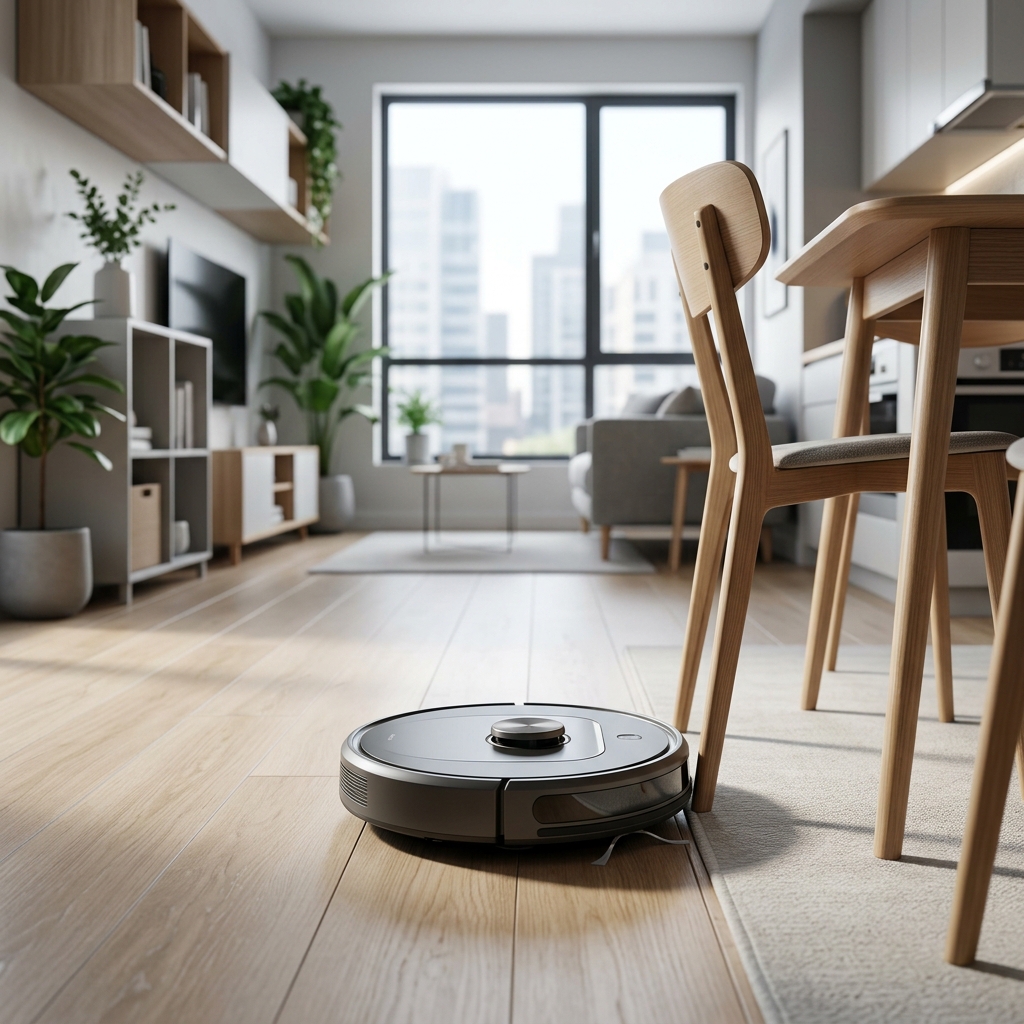
Small flats present unique cleaning challenges. Limited space often means furniture is closely arranged, leaving less room to manoeuvre with a traditional vacuum. Maintaining cleanliness can feel like a constant battle, especially with busy lifestyles. This is where a robot vacuum truly shines. They’re designed to navigate these tight spaces, reaching under furniture and into corners with ease. The convenience is unparalleled—simply schedule a cleaning cycle, and the robot takes care of the rest, freeing up your valuable time. Robot vacuums are particularly beneficial for flat dwellers because they maintain a consistent level of cleanliness in a smaller area, preventing dust and debris build-up that can quickly become noticeable. They excel at quick daily cleans, perfect for keeping a compact living space looking its best.
What to Look for in a Robot Vacuum for Small Flats (2026)
When choosing a robot vacuum for a small flat, several key features should be prioritised. By 2026, we’re seeing significant advancements in these areas, making the options even more compelling.
Size and Profile
A low profile is crucial! You need a robot that can easily glide under sofas, beds, and other furniture common in flats. Look for models under 9cm in height. Compact designs are also beneficial for navigating tight spaces.
Suction Power
Most flats feature hard floors or low-pile carpets. While extremely high suction isn’t always necessary, sufficient power is needed to effectively remove dust, crumbs, and pet hair. Look for models offering at least 2000Pa of suction.
Battery Life
Adequate battery life is essential to ensure the robot can cover your entire flat on a single charge. For most small flats (under 70sqm), 60-90 minutes of runtime should be sufficient. Models that can automatically return to their charging dock and resume cleaning are highly desirable.
Navigation
This is arguably the most important feature. Advanced navigation systems, like LiDAR and SLAM (Simultaneous Localization and Mapping), allow the robot to create a map of your flat and clean efficiently, avoiding obstacles. Improvements in AI by 2026 mean better object recognition and avoidance – they’re getting much better at dodging cables, shoes, and other everyday items.
Smart Features
App control, scheduling, and virtual walls/no-go zones provide greater flexibility and customisation. Smart home integration (Alexa, Google Assistant) allows for voice control. Some models even offer multi-floor mapping, useful if you have a small maisonette.
Noise Level
Consider the noise level, especially if you live in a shared building or work from home. Robot vacuums are becoming increasingly quiet; look for models with a noise level below 65dB. Newer models boast even quieter operation due to improved motor designs and sound dampening technologies.
Top 5 Robot Vacuums for Small Flats (2026) – Our Picks
1. iRobot Roomba i7+
Price: £399.99
The Roomba i7+ remains a solid choice, known for its powerful suction and intelligent mapping. Its self-emptying base is a huge convenience.
Pros: Excellent suction, self-emptying base, smart mapping, good app control.
Cons: Relatively expensive, can struggle with very small objects.
2. Ecovacs Deebot N8 Pro+
Price: £279.99
The Deebot N8 Pro+ offers a fantastic balance of features and price. It boasts strong suction, mopping capabilities, and a self-emptying bin.
Pros: Good value for money, mopping function, self-emptying, accurate navigation.
Cons: Suction not as powerful as the Roomba i7+, mopping function is basic.
3. Shark IQ Robot Vacuum RV750
Price: £199.99
A budget-friendly option that still delivers impressive performance. The Shark IQ is easy to use and effective at picking up everyday dirt and debris.
Pros: Affordable, simple to use, good for hard floors, self-emptying base.
Cons: Basic navigation, limited smart features, not ideal for thick carpets.
4. Roborock S7 MaxV Ultra
Price: £799.99
The premium option. The Roborock S7 MaxV Ultra offers top-of-the-line features, including advanced obstacle avoidance, sonic mopping, and a fully automated docking station that washes and dries the mop.
Pros: Exceptional cleaning performance, advanced obstacle avoidance, sonic mopping, fully automated docking station.
Cons: Very expensive, potentially overkill for a very small flat.
5. Neato Robotics D8
Price: £349.99
The Neato D8 features a distinctive D-shape design that allows it to clean closer to edges and corners than many other robot vacuums. It’s a good all-rounder with strong suction and reliable navigation.
Pros: Excellent edge cleaning, strong suction, good navigation, competitive price.
Cons: App can be buggy, slightly larger than some competitors.
Robot Vacuum Features Explained: Mapping, Suction & More
LiDAR/SLAM Mapping
LiDAR (Light Detection and Ranging) uses lasers to scan the room and create a detailed map. SLAM (Simultaneous Localization and Mapping) combines this with sensor data to allow the robot to understand its location and navigate effectively. Better mapping means less bumping into furniture and more efficient cleaning.
Suction Power (Pa)
Measured in Pascals (Pa), suction power determines how effectively the robot picks up dirt and debris. Higher Pa values generally indicate stronger suction. For most flats, 2000-3000Pa is sufficient.
Brush Types
Different brush types are designed for different floor types. Rubber brushes are ideal for hard floors as they don’t scratch. Bristle brushes are better for carpets, lifting dirt and debris from the fibres. Many robots have a combination of both.
HEPA Filters
HEPA (High-Efficiency Particulate Air) filters trap allergens like dust mites, pollen, and pet dander, making them essential for allergy sufferers.
Virtual Walls/No-Go Zones
These features allow you to define areas where you don’t want the robot to clean, such as around delicate furniture or pet bowls. They can be set up using the robot’s app or with physical barriers.
Maintaining Your Robot Vacuum: Tips for Longevity
Regular maintenance is crucial to ensure your robot vacuum continues to perform optimally.
- Empty the Dustbin: After each cleaning cycle, or more frequently if you have pets.
- Clean the Brushes: Remove tangled hair and debris from the brushes regularly.
- Replace Filters: HEPA filters should be replaced every 3-6 months, depending on usage.
- Troubleshooting: Check the user manual for solutions to common issues.
- Battery Care: Avoid completely draining the battery, and store the robot in a cool, dry place.
Expect to spend around £30-£50 per year on replacement filters and brushes. More complex repairs can cost £80-£200 depending on the issue and the model.
Robot Vacuums vs. Traditional Vacuums: Which is Best?
For small flat dwellers, a robot vacuum offers unmatched convenience for maintaining daily cleanliness. However, they aren’t a complete replacement for traditional vacuums.
Robot Vacuums:
- Pros: Convenient, automated, good for daily maintenance, reach under furniture.
- Cons: Can struggle with very thick carpets, less powerful than traditional vacuums, require maintenance.
Traditional Vacuums:
- Pros: More powerful, better for deep cleaning, versatile for different surfaces.
- Cons: Time-consuming, require physical effort, can be bulky to store.
A robot vacuum is ideal for keeping your flat consistently clean, while a traditional vacuum is best for occasional deep cleans and tackling specific messes.
Frequently Asked Questions (FAQs)
Are robot vacuums suitable for pet hair?
Yes, many robot vacuums are designed to handle pet hair. Look for models with strong suction and tangle-free brushes. The iRobot Roomba i7+ and Roborock S7 MaxV Ultra are particularly good at dealing with pet hair.
How loud are robot vacuums?
Noise levels vary between models. Generally, they operate between 60-70dB. Newer models are becoming increasingly quiet, with some operating below 65dB.
How often do robot vacuums need emptying?
The frequency depends on the size of your flat, the amount of dirt and debris, and whether the robot has a self-emptying base. With a self-emptying base, you might only need to empty it every few weeks. Without one, daily or every other day is common.
Can robot vacuums handle thresholds?
Most robot vacuums can handle thresholds up to 1-2cm high. However, very high thresholds may pose a problem. Check the manufacturer’s specifications.
What about smart home integration?
Many robot vacuums are compatible with popular smart home platforms like Amazon Alexa and Google Assistant, allowing you to control them with voice commands.