
Table of Contents
As an Amazon Associate, we earn from qualifying purchases. This means we may receive a small commission at no extra cost to you when you buy through links on this page.
Why a Robot Vacuum is Ideal for Open Plan Living
Open plan living has become increasingly popular, creating spacious and sociable homes. However, keeping these large, often multi-functional areas clean can be a significant challenge. Traditional vacuuming requires maneuvering around furniture, switching between floor types, and dedicating considerable time and effort. This is where robot vacuums shine.
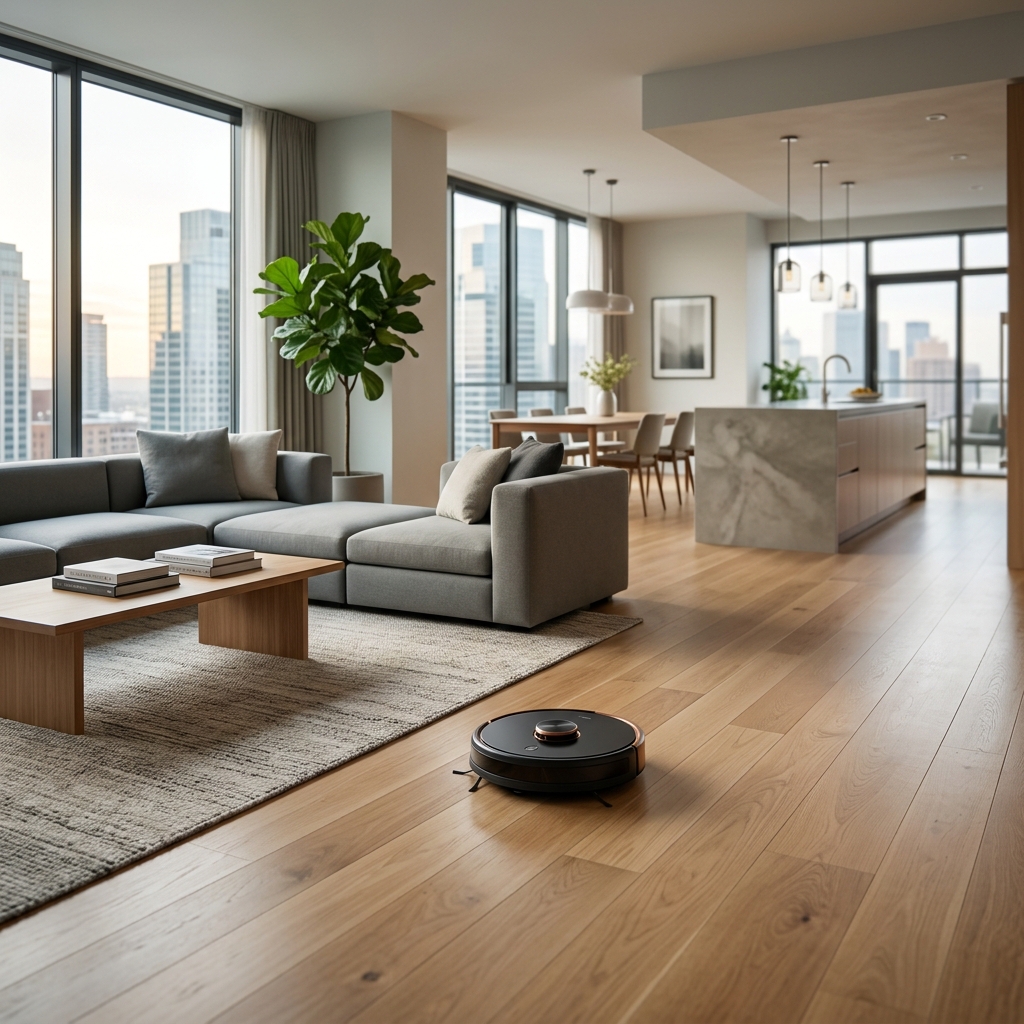
Robot vacuums excel in open plan spaces for several key reasons. They can cover large areas efficiently, navigating around furniture with ease. Most modern models seamlessly transition between hardwood floors, carpets, and tiles, adjusting suction power accordingly. Crucially, they significantly reduce cleaning time, allowing you to focus on other priorities. The convenience of scheduled cleaning and remote control via smartphone apps makes maintaining a spotless open plan home easier than ever before.
Key Features to Look for in 2026
The robot vacuum market has evolved rapidly. In 2026, several features are essential for an open plan home:
- Advanced Navigation (LiDAR, vSLAM): Crucial for mapping your home accurately and avoiding obstacles. LiDAR (Light Detection and Ranging) is now standard in premium models, offering superior precision. vSLAM (Visual Simultaneous Localization and Mapping) uses cameras for navigation, becoming increasingly sophisticated.
- Powerful Suction: Measured in Pascals (Pa), higher numbers indicate stronger suction. For open plan homes with mixed floor types, a suction power of 3000Pa or higher is recommended.
- Multi-Surface Brush Rolls: Brush rolls designed to effectively clean both hard floors and carpets are vital. Look for models offering automatic brush roll adjustment.
- Zone Cleaning & No-Go Zones: The ability to define specific cleaning zones and restrict access to certain areas (e.g., pet bowls, cable clusters) is essential for customisation.
- App Control & Smart Home Integration: Remote control via a smartphone app, along with compatibility with voice assistants like Alexa and Google Assistant, adds convenience.
- Battery Life: Extended battery life is essential for cleaning larger open plan areas on a single charge. Look for models with at least 90 minutes of runtime.
- Auto-Emptying Docks: Increasingly common, these docks automatically empty the robot’s dustbin, reducing the frequency of manual emptying.
Top Robot Vacuum Picks for Open Plan Spaces (2026)
iRobot Roomba j9+ (Complete Clean) – £1299
The Roomba j9+ remains a top contender, known for its exceptional cleaning performance and intelligent navigation. It excels at avoiding obstacles, including cables and pet waste. The Complete Clean package includes the auto-empty dock.
Cons: Relatively expensive, app can be complex for some users.
Shark AI Ultra Robot Vacuum – £899
Shark’s AI Ultra offers a great balance of performance and price. Its AI Laser Navigation accurately maps your home, and its self-cleaning brushroll is a standout feature.
Cons: Battery life is slightly shorter than some competitors.
Ecovacs Deebot X2 Omni – £1499
The Deebot X2 Omni is a premium option boasting a fully integrated Omni Station – washing and drying the mop pads, and auto-emptying the dustbin. It offers strong suction and advanced object avoidance.
Cons: Very expensive, Omni Station is large.
Roborock S8 Pro Ultra – £1349
Roborock’s S8 Pro Ultra delivers exceptional cleaning performance, with its VibraRise 2.0 Mopping System automatically lifting the mop when encountering carpets. It also includes an auto-empty dock and self-washing mop function.
Cons: Can be noisy on hard floors.
DreameBot L20s Ultra – £1199
The DreameBot L20s Ultra offers a comprehensive cleaning solution, including auto-emptying, mop washing, and drying. Its advanced obstacle avoidance system and strong suction make it a competitive choice.
Cons: Dustbin capacity could be larger.
Samsung Jet Bot AI+ – £999
The Jet Bot AI+ utilises AI Object Recognition to identify and avoid obstacles with greater precision. It also boasts a powerful suction motor and a long-lasting battery.
Cons: Auto-empty dock sold separately.
Neato Robotics D10 – £749
Neato’s D10 is a more affordable option with a distinctive D-shape design that allows it to clean closer to edges and corners. It offers good suction and reliable navigation.
Cons: Navigation isn’t as advanced as LiDAR-equipped models.
Understanding Robot Vacuum Navigation Systems
| Navigation System | How it Works | Performance in Open Plan Spaces | Pros | Cons |
|---|---|---|---|---|
| Random Bounce | Bumps around randomly until battery is low. | Poor – inefficient and often misses spots. | Very affordable. | Inefficient, inaccurate, struggles with obstacles. |
| Gyro-navigation | Uses gyroscopes to navigate in straight lines. | Moderate – better than random bounce, but can still get lost. | More affordable than vSLAM/LiDAR. | Less accurate than vSLAM/LiDAR, struggles with complex layouts. |
| vSLAM (Visual Simultaneous Localization and Mapping) | Uses cameras to create a map of your home. | Good – accurate mapping and object avoidance. | Good accuracy, affordable compared to LiDAR. | Performance can be affected by low light. |
| LiDAR | Uses lasers to create a detailed map of your home. | Excellent – most accurate and reliable navigation. | Highly accurate, works well in all lighting conditions. | More expensive than other systems. |
Suction Power and Brush Roll Types: What You Need to Know
Suction Power: Measured in Pascals (Pa), higher Pa values mean stronger suction. For open plan homes with a mix of hard floors and carpets, 3000Pa or more is recommended. This ensures effective debris removal from both surfaces.
Brush Roll Types:
- Main Brush: Typically a cylindrical brush rotating to agitate and lift dirt. Bristle brushes are good for carpets, while rubber brushes are better for hard floors and pet hair.
- Side Brushes: Sweep debris from edges and corners into the path of the main brush.
- Rubber Brushes: Excellent for pet hair and preventing tangles. Gentle on hard floors.
- Bristle Brushes: Effective at deep cleaning carpets but can require more maintenance.
Maintaining Your Robot Vacuum for Peak Performance
Regular maintenance is crucial for extending the lifespan and maintaining the cleaning performance of your robot vacuum:
- Empty the Dustbin: After each cleaning cycle, or more frequently if you have pets.
- Clean Brushes: Remove hair and debris tangled around the brush rolls at least once a week.
- Replace Filters: Filters should be replaced every 2-3 months, depending on usage.
- Check Sensors: Ensure sensors are clean and unobstructed for accurate navigation.
- Troubleshooting: Refer to the user manual for troubleshooting common issues.
Robot Vacuums vs. Traditional Vacuums for Open Plan Living: A Comparison
| Feature | Robot Vacuum | Traditional Vacuum |
|---|---|---|
| Convenience | High – automated cleaning, scheduled operation. | Low – requires manual operation. |
| Cleaning Effectiveness | Good – effective for daily maintenance. | Excellent – for deep cleaning and specific messes. |
| Cost | £700 – £1500+ | £100 – £800+ |
| Maintenance | Moderate – emptying dustbin, cleaning brushes, replacing filters. | Moderate – emptying dustbin, replacing bags (if applicable), cleaning filters. |
| Suitability for Open Plan | Excellent – designed for large areas and navigating furniture. | Good – but requires more effort and time. |
Future Trends in Robot Vacuum Technology (2026 & Beyond)
The future of robot vacuums is bright. Expect to see:
- Advanced Object Recognition: Improved AI will allow robots to identify and avoid a wider range of objects, including shoes, toys, and pet accidents.
- AI-Powered Cleaning: Robots will learn your cleaning preferences and adapt their cleaning routes accordingly.
- Self-Emptying Docks with Larger Capacity: Docks will hold more debris, reducing the frequency of emptying.
- Integration with Other Smart Home Devices: Seamless integration with smart lighting, security systems, and other devices.
- More Affordable LiDAR Technology: LiDAR navigation will become more accessible in mid-range models.
FAQ
Q: How often should I run my robot vacuum?
For open plan living, running your robot vacuum 3-5 times a week is ideal for maintaining a consistently clean floor. You can schedule it to run automatically while you’re away.
Q: Can robot vacuums handle pet hair?
Yes, many models are specifically designed to handle pet hair, featuring tangle-free brush rolls and powerful suction. Look for models with rubber brushes for optimal pet hair removal.
Q: What if my robot vacuum gets stuck?
Most modern robot vacuums are equipped with sensors to prevent getting stuck. However, if it does get stuck, the app will usually send a notification. You can manually override the robot and rescue it.
Q: Is a self-emptying dock worth the extra cost?
For busy households, a self-emptying dock is a worthwhile investment. It significantly reduces the frequency of manual emptying, saving you time and effort.
Q: How long do robot vacuum batteries last?
Battery life varies depending on the model and usage. Most modern robot vacuums offer 90-120 minutes of runtime on a single charge. Some models will automatically return to the dock to recharge and resume cleaning.