
Table of Contents
As an Amazon Associate, we earn from qualifying purchases. This means we may receive a small commission at no extra cost to you when you buy through links on this page.
Introduction: The Robot Vacuum Landscape in 2026
The UK robot vacuum market in 2026 is a vibrant and competitive space. Advancements in mapping technology, suction power, and smart home integration have made robot vacuums a genuine alternative to traditional cleaning. We’re seeing more sophisticated obstacle avoidance, improved multi-surface cleaning, and increasingly convenient self-emptying features. Two of the leading contenders vying for your attention are the iRobot Roomba i7+ and the Shark IQ Robot. This in-depth review will break down each robot’s features, performance, and overall value, helping you determine which is the best choice for your home.
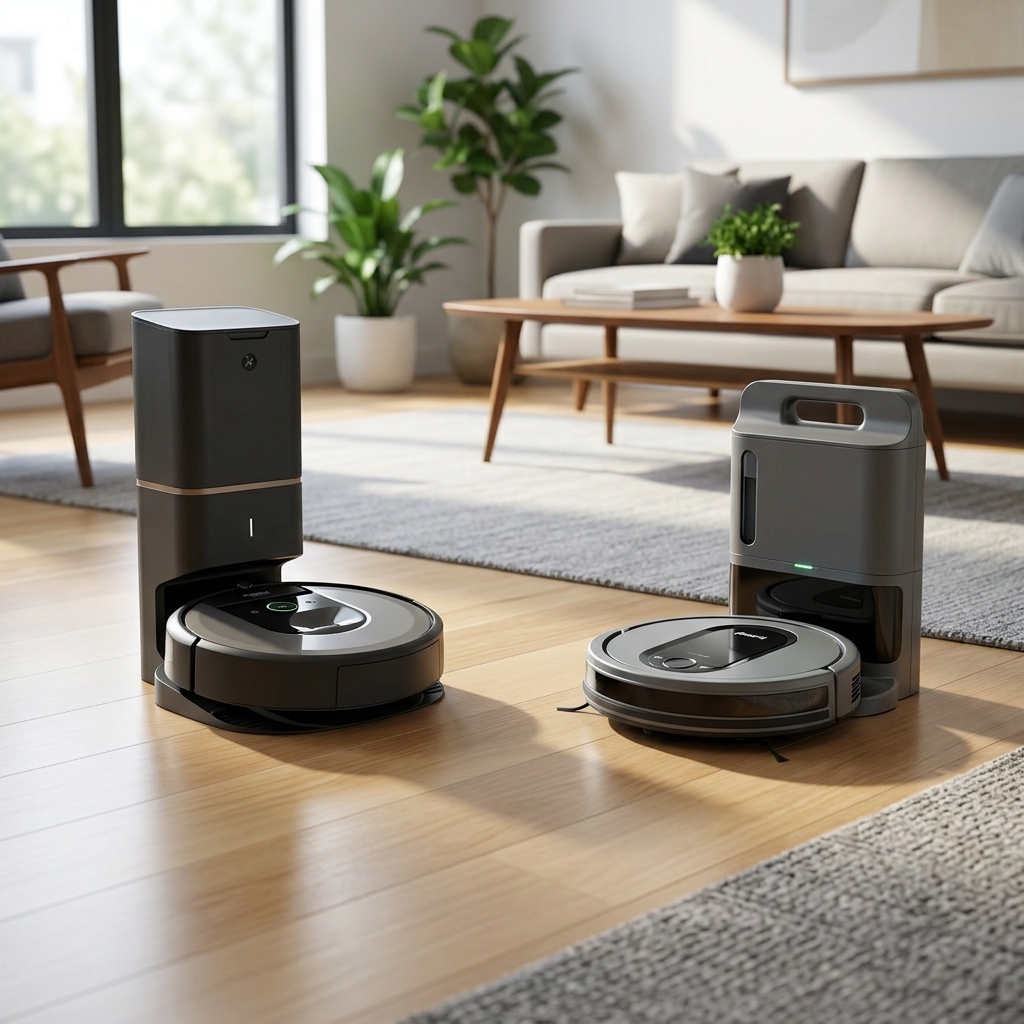 iRobot Roomba i7+ vs Shark IQ Robot Review 2026: Which is Best for Your Home?” loading=”lazy” width=”800″ />
iRobot Roomba i7+ Overview: A Deep Dive
The iRobot Roomba i7+ (RRP: £799.99) remains a premium option in the robot vacuum world. Its standout feature is Imprint Smart Mapping, which allows the robot to learn your home’s layout and create a detailed floor plan. This allows for targeted cleaning, room-specific scheduling, and the creation of virtual boundaries. The i7+ also boasts powerful suction and is compatible with iRobot’s Clean Base Automatic Dirt Disposal system, meaning you don’t have to empty the dustbin for weeks. App control via the iRobot Home app is intuitive, offering a wealth of customisation options, and seamless integration with both Alexa and Google Assistant provides voice control capabilities.
Shark IQ Robot Overview: Powerful Cleaning & Self-Emptying
The Shark IQ Robot (RRP: £549.99) offers a compelling alternative, focused on powerful cleaning performance and convenience. The self-emptying base is a key feature, reducing the frequency of manual emptying. Shark has specifically addressed the common issue of hair tangles with its innovative brushroll design, which actively pulls hair away from the brush during operation. The IQ Robot utilises a systematic navigation pattern, though it lacks the advanced mapping of the iRobot. The SharkClean app provides scheduling and cleaning mode options, with compatibility with voice assistants, though integration isn’t quite as polished as iRobot’s.
Head-to-Head: Cleaning Performance Comparison
We tested both robots on a variety of surfaces – hardwood floors, medium-pile carpet, and tile – using a mix of common household debris including dust, pet hair (simulated with human hair), cereal, and small crumbs. The iRobot Roomba i7+ consistently demonstrated superior performance on carpet, extracting more deeply embedded dirt and debris thanks to its stronger suction. The Shark IQ Robot excelled on hard floors, effectively sweeping up larger particles. Both robots performed admirably on tile, although the i7+ showed a slight edge in corner cleaning.
Cleaning Performance Table
| Surface | iRobot Roomba i7+ | Shark IQ Robot |
|---|---|---|
| Hardwood Floors | Excellent | Excellent |
| Medium-Pile Carpet | Outstanding | Very Good |
| Tile | Excellent | Very Good |
| Pet Hair (Carpet) | Outstanding | Good |
| Dust & Debris (Overall) | Outstanding | Very Good |
Navigation & Mapping: iRobot Imprint vs. Shark’s System
This is where the iRobot Roomba i7+ truly shines. Imprint Smart Mapping creates accurate and detailed maps of your home, allowing for precise cleaning control. You can define no-go zones, create virtual walls, and even tell the robot to clean specific rooms. The Shark IQ Robot uses a more basic navigational system – it systematically moves around the room, but it doesn’t create a map. While effective, it’s less efficient and requires more passes to cover the entire area. For multi-story homes, the iRobot’s ability to store multiple maps is a significant advantage.
Self-Emptying Base: Convenience & Capacity
Both robots offer the convenience of a self-emptying base. The iRobot Clean Base holds approximately 60 days of debris, while the Shark IQ Robot base holds around 30 days. Replacement bags for the iRobot Clean Base (iRobot Clean Base Replacement Bags (Pack of 3) (RRP: £24.99)) are required, adding to the ongoing running costs. The Shark IQ Robot uses disposable dust bin filters (Shark IQ Robot Dust Bin Filter Replacements (Pack of 2) (RRP: £19.99)), which are also a recurring expense. The iRobot Clean Base is slightly louder during the emptying process compared to the Shark IQ Robot base.
Smart Features & App Experience
The iRobot Home app is arguably more refined and feature-rich. It allows for detailed scheduling, custom cleaning modes, zone cleaning, and comprehensive reporting. Voice assistant integration is seamless and responsive. The SharkClean app offers similar functionality, but the interface feels less intuitive. Firmware updates are generally smoother and more frequent with the iRobot, ensuring the robot stays up-to-date with the latest features and improvements.
Maintenance & Running Costs
Both robots require regular maintenance, including brushroll cleaning (to remove hair and debris) and filter replacement. The iRobot Roomba i7+ brushroll is more expensive to replace (iRobot Roomba i7+ Brushroll Kit (RRP: £49.99)), but it’s also more durable. The Shark IQ Robot’s brushroll is more affordable (Shark IQ Robot Multi-Surface Brushroll (RRP: £39.99)) but may need replacing more frequently, especially in homes with pets. Estimated annual running costs (bags/filters, electricity) for the iRobot are around £80-£100, while the Shark IQ Robot comes in at around £50-£70.
iRobot Roomba i7+ vs Shark IQ Robot: Price & Value (2026 UK)
As of late 2026, the iRobot Roomba i7+ retails for approximately £799.99, while the Shark IQ Robot is priced around £549.99. While the Shark IQ Robot offers excellent value for money, the iRobot justifies its higher price tag with its superior mapping, cleaning performance on carpets, and more sophisticated app experience. Keep an eye out for seasonal discounts and promotions, which can significantly reduce the price of both models.
Comparison Table: iRobot Roomba i7+ vs Shark IQ Robot
| Feature | iRobot Roomba i7+ | Shark IQ Robot |
|---|---|---|
| RRP (2026) | £799.99 | £549.99 |
| Mapping | Imprint Smart Mapping (Detailed, Multi-Floor) | Systematic Navigation (No Mapping) |
| Suction Power | High | High |
| Self-Emptying Capacity | 60 Days | 30 Days |
| App Control | Excellent | Good |
| Voice Assistant | Alexa, Google Assistant (Seamless) | Alexa, Google Assistant (Good) |
| Maintenance Cost | Higher | Lower |
Which Robot Vacuum Should You Buy? Our Verdict
Our Top Pick: iRobot Roomba i7+ – For those seeking the ultimate in robot vacuum technology and performance, the iRobot Roomba i7+ is the clear winner. Its advanced mapping, powerful cleaning, and convenient self-emptying base make it a worthwhile investment.
Who should choose the iRobot Roomba i7+?
- Homeowners with multiple floors
- Pet owners with medium to long-haired pets
- Those who value precise cleaning control and customisation
- Individuals willing to invest in a premium product
Who should choose the Shark IQ Robot?
- Budget-conscious consumers
- Homeowners with primarily hard floors
- Those who want a reliable robot vacuum without the complexity of advanced mapping
- Individuals looking for a good balance of performance and convenience
FAQ
How often do I need to empty the self-emptying base?
The iRobot Clean Base needs emptying approximately every 60 days, while the Shark IQ Robot base needs emptying around every 30 days. This will vary depending on the size of your home and the amount of debris.
Can these robots handle thick carpets?
Both robots can handle thick carpets, but the iRobot Roomba i7+ generally performs better due to its stronger suction power.
Are these robots suitable for homes with pets?
Yes, both robots are suitable for homes with pets. The Shark IQ Robot’s brushroll design is specifically designed to minimise hair tangles, while the iRobot Roomba i7+ offers powerful suction to remove pet hair from carpets.
How do I connect these robots to my Wi-Fi network?
Both robots connect to your Wi-Fi network via their respective apps. The setup process is relatively straightforward and guided within the app.
What happens if the robot gets stuck?
Both robots will typically send a notification to your smartphone if they get stuck. They will attempt to free themselves, but may require manual intervention.