
Table of Contents
As an Amazon Associate, we earn from qualifying purchases. This means we may receive a small commission at no extra cost to you when you buy through links on this page.
Introduction: The Rise of Robot Vacuums for Large Homes
Robot vacuums have exploded in popularity in recent years, and for good reason. Maintaining a clean home, particularly a large one, can be a significant time commitment. Here in the UK, where many of us enjoy homes with multiple rooms and varying floor types, the challenge is amplified. In 2026, advancements in AI, mapping technology, and battery life make robot vacuums a more practical and effective cleaning solution than ever before. They’re no longer just novelty items; they’re genuine time-savers, allowing you to focus on enjoying your space rather than constantly cleaning it. This guide will navigate you through the key considerations when selecting the best robot vacuum for your large UK home.
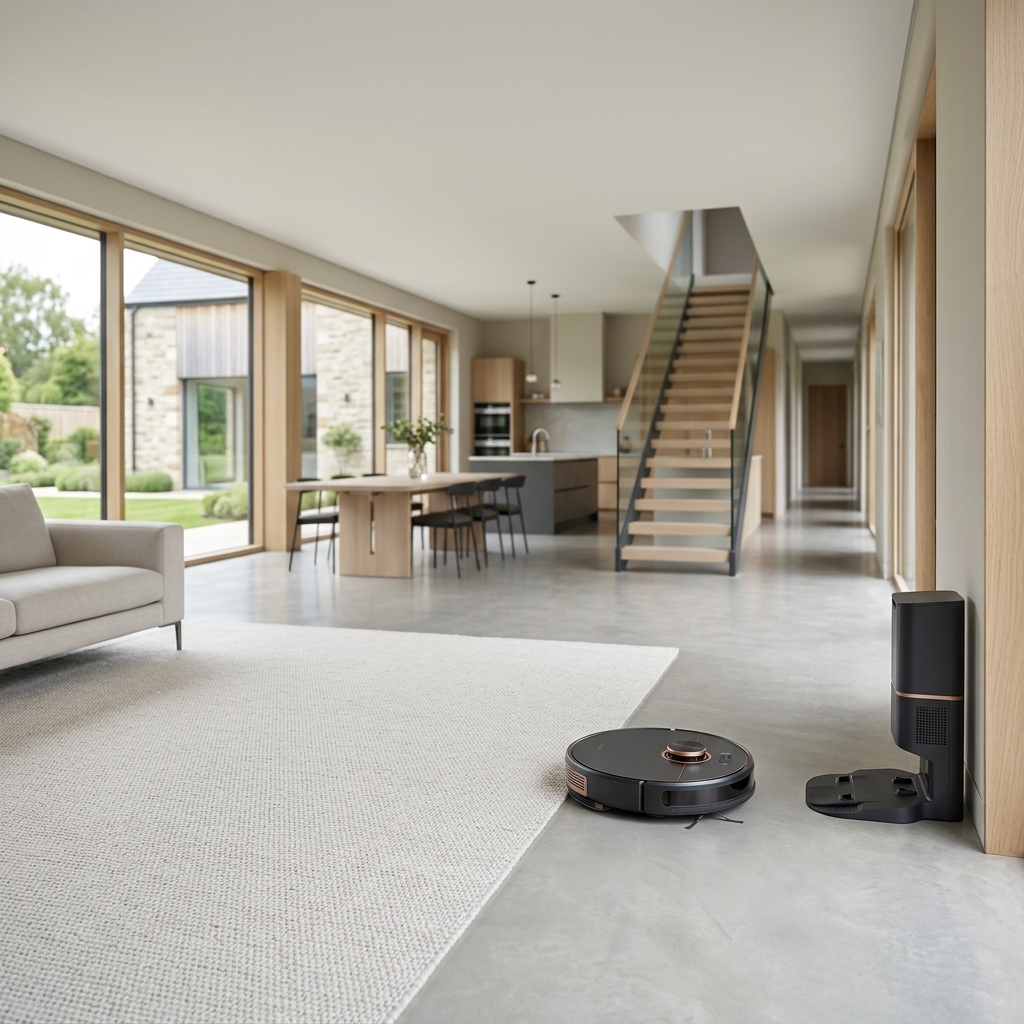
Understanding Your Cleaning Needs: Size & Floor Types
Before diving into specific models, honestly assess your cleaning needs. Consider these factors:
- Square Footage: How many square metres does your home cover? Larger homes (over 200m²) will necessitate models with longer battery life and larger dustbin capacities.
- Number of Floors: Do you have a multi-story home? Crucially, does the robot vacuum offer multi-floor mapping? Some models require you to physically move the robot between floors, while others can store multiple maps.
- Floor Types: Is your flooring predominantly carpet, hardwood, tile, or a mix? Different brushroll designs are optimised for different surfaces. High-pile carpets require stronger suction and specialised brushrolls.
- Obstacles: How cluttered is your home? Furniture, rugs, and pet toys all pose challenges. Object recognition and avoidance features become vital in obstacle-rich environments.
- Pets: Pet hair is a significant consideration. Look for models specifically designed to handle pet hair, with tangle-free brushrolls and powerful suction.
Key Features to Look For in 2026 Robot Vacuums
Here’s a breakdown of the essential features to consider:
- Suction Power (Pa): Measured in Pascals (Pa), higher suction power generally means better cleaning performance, particularly on carpets. 2000Pa is a good starting point, with 3000Pa+ being ideal for pet owners and deep cleaning.
- Battery Life (Runtime and Charging): Runtime is crucial for large homes. Aim for at least 90-120 minutes. Auto-charging and ‘return to base’ functionality are essential. Look for models that intelligently resume cleaning after recharging.
- Dustbin Capacity: Larger dustbins reduce the frequency of emptying. 0.5L is a standard capacity, but self-emptying bases offer significantly more convenience.
- Brushroll Types: Dual brushrolls are common, with one designed to agitate dirt and the other to sweep it up. Rubber brushrolls are better for hard floors, while bristle brushrolls are better for carpets. Tangle-free designs are vital for pet owners.
- Filter Types: HEPA filters are essential for allergy sufferers, trapping dust mites, pollen, and other allergens. Consider models with multi-stage filtration systems.
Mapping Technology: Crucial for Large Homes
Accurate mapping is paramount for efficient cleaning in large homes. Here’s a comparison of the common technologies:
| Technology | Description | Pros | Cons | Best For |
|---|---|---|---|---|
| LiDAR | Uses laser beams to create a precise map of your home. | Highly accurate, excellent for complex layouts, fast mapping. | Can be more expensive. | Large, complex homes with multiple rooms and obstacles. |
| vSLAM | Uses visual sensors and algorithms to create a map. | More affordable than LiDAR, good for general navigation. | Can struggle in low-light conditions, less accurate than LiDAR. | Smaller to medium-sized homes with simpler layouts. |
| Camera-Based | Relies on a camera to ‘see’ and map the environment. | Can identify objects (with advanced models), potentially lower cost. | Privacy concerns, can be affected by lighting, less reliable than LiDAR. | Homes with clear pathways and good lighting. |
Smart Features & App Control: Convenience & Customisation
Modern robot vacuums offer a wealth of smart features. Key benefits include:
- App Control: Start, stop, and schedule cleaning sessions remotely.
- Scheduling: Set cleaning schedules to automate the process.
- Zone Cleaning: Specify areas for targeted cleaning.
- Spot Cleaning: Focus cleaning on a specific area.
- Voice Assistant Compatibility: Control the robot with voice commands via Alexa or Google Assistant.
- No-Go Zones: Create virtual boundaries to prevent the robot from entering restricted areas (e.g., near delicate furniture).
Reliable app functionality is crucial. Check user reviews regarding app stability and ease of use.
Robot Vacuum Types: Which is Best for You?
The market offers various robot vacuum types:
- Basic Models: Affordable, but lack advanced features like mapping or app control. Suitable for small, simple homes.
- Wi-Fi Connected Models: Offer app control and scheduling. A good balance of price and features.
- Self-Emptying Bases: Automatically empty the dustbin into a larger container, reducing maintenance. Highly convenient, but more expensive.
- Mopping Robots (2-in-1): Combine vacuuming and mopping functionality. Useful for homes with predominantly hard floors.
- Robots with Object Recognition/Avoidance: Use AI to identify and avoid obstacles, such as shoes, cables, and pet waste. Essential for cluttered homes.
Top Robot Vacuum Recommendations for Large UK Homes (2026)
Here are some top contenders for large UK homes:
| Model | Price (approx.) | Key Features | Pros | Cons |
|---|---|---|---|---|
| iRobot Roomba j7+ (Self-Emptying) | £799 | PrecisionVision Navigation, Self-Emptying Base, Smart Mapping, Object Recognition. | Excellent object avoidance, reliable performance, effective cleaning. | Relatively expensive, can be loud. |
| Shark AI Ultra Robot Vacuum | £649 | AI Laser Navigation, Self-Emptying Base, Multi-Surface Brushroll, Advanced Sensors. | Strong suction, good value for money, effective on all floor types. | App can be occasionally buggy. |
| Ecovacs Deebot X2 Omni | £1199 | AIVI 3.0, Omni Station (Self-Emptying, Mopping, Hot Air Drying), TrueMapping 6.0. | Comprehensive cleaning solution, advanced AI, excellent mopping performance. | Very expensive, complex setup. |
| Roborock S8 Pro Ultra | £1099 | ReactiveAI 2.0 Obstacle Avoidance, DuoRoller Brush, Sonic Mopping, Empty Rock Dock. | Powerful suction, excellent navigation, impressive mopping capabilities. | Can struggle with very dark carpets. |
| Dyson 360 Vis Nav Robot Vacuum | £899 | 360° Vision System, Powerful Suction, HEPA Filtration, Dyson Link App. | Strong suction, effective filtration, stylish design. | Expensive, dustbin capacity could be larger. |
Maintenance & Running Costs: What to Expect
Robot vacuums require regular maintenance:
- Dustbin Emptying: Frequency depends on dustbin capacity and usage. Self-emptying bases significantly reduce this task.
- Brushroll Cleaning: Remove tangled hair and debris from the brushrolls regularly.
- Filter Replacement: HEPA filters should be replaced every 3-6 months (approx. £20-£40 per filter).
- Brushroll Replacement: Brushrolls will wear out over time and need replacing (approx. £30-£60).
Electricity costs are relatively low (typically less than £5 per year). The biggest ongoing cost is replacement parts.
Troubleshooting Common Robot Vacuum Issues
Here are some common problems and solutions:
- Getting Stuck: Identify and remove obstacles, create no-go zones for problem areas.
- Navigation Errors: Ensure adequate lighting, clean sensors, and update the map.
- Poor Suction: Empty the dustbin, clean the filters, and check for blockages in the suction path.
- Connectivity Issues: Check your Wi-Fi connection, restart the robot and app.
Conclusion: Investing in a Cleaner Home
Choosing the right robot vacuum for your large UK home is an investment in your time and wellbeing. By carefully considering your cleaning needs, key features, and budget, you can find a model that effectively maintains a clean and healthy living environment. In 2026, with the advancements in robotic vacuum technology, the benefits of automation are more compelling than ever before. Don’t hesitate to read user reviews and compare models before making your final decision.
FAQ
- Q: How often should I run my robot vacuum?
- A: For large homes, 2-3 times per week is generally sufficient. You can schedule daily runs for high-traffic areas.
- Q: Are robot vacuums noisy?
- A: Noise levels vary between models. Look for models with ‘quiet mode’ if noise is a concern.
- Q: Can robot vacuums handle thick carpets?
- A: Yes, but choose a model with powerful suction and a specialised brushroll designed for carpets.
- Q: What is the best way to prepare my home for a robot vacuum?
- A: Clear the floor of obstacles, secure loose cables, and create no-go zones for areas you want to avoid.
- Q: Will a robot vacuum replace my traditional vacuum cleaner completely?
- A: While robot vacuums are excellent for maintaining cleanliness, a traditional vacuum cleaner is still useful for deep cleaning and tackling difficult areas.