
Affiliate disclosure: this article contains paid links. As an Amazon Associate I earn from qualifying purchases.
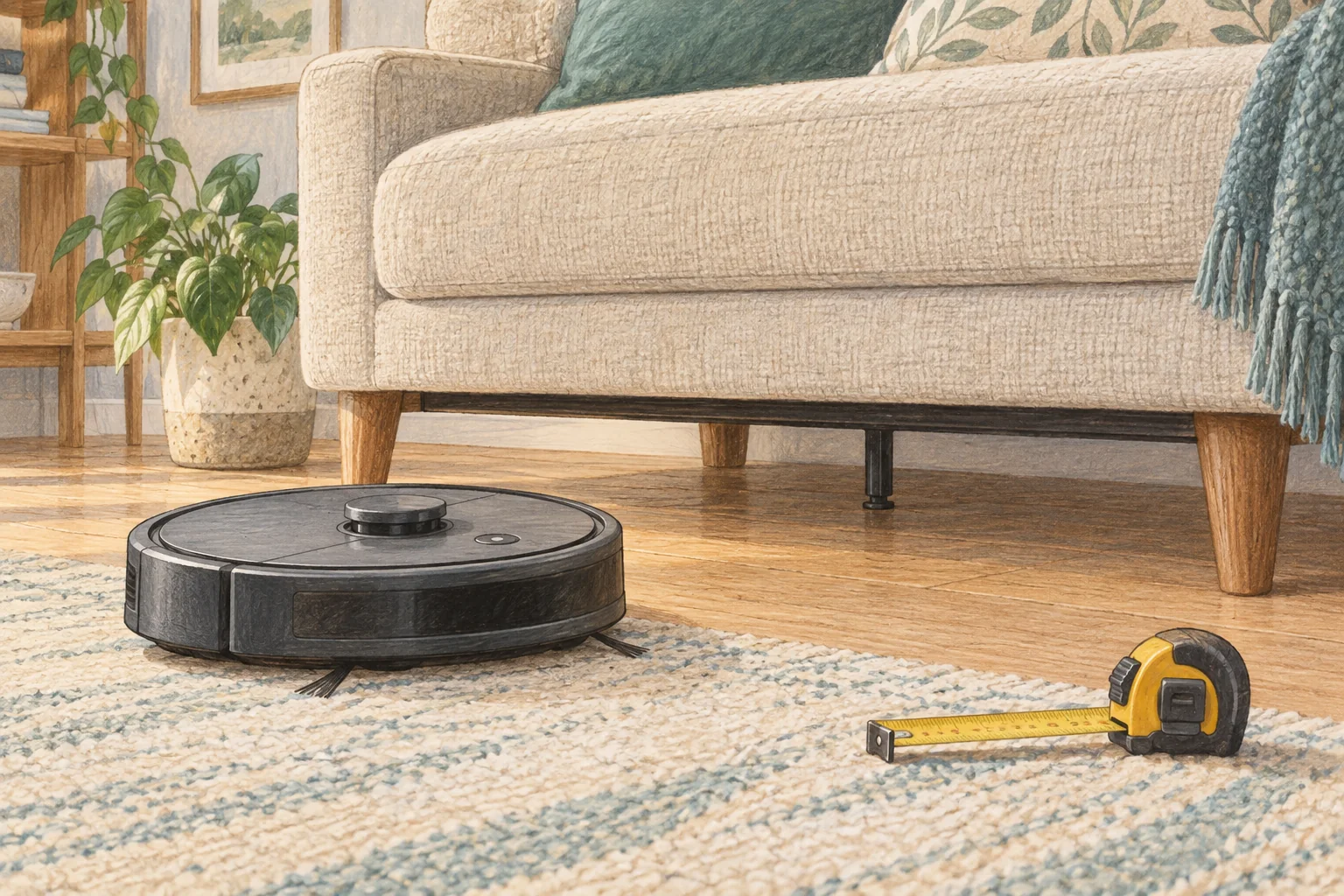
A retracting navigation turret can reduce a robot's height in suitable situations. Buyers still need to know both its lowered height and the conditions under which it retracts.
Table of Contents
A practical checklist
- Measure the lowest point beneath furniture along the whole route.
- Read the model's raised and lowered dimensions.
- Leave practical clearance rather than matching the furniture gap exactly to a brochure figure.
What this looks like at home
Saros 10 is listed at 79.8 mm lowered and 93.5 mm raised, so one height figure does not describe every moment of travel.
Measure the lowest point along the full route
| Check | What matters |
|---|---|
| Front gap | Measure the rigid opening. |
| Inside route | Check support rails, fabric and stored items. |
| Exit | Make sure turning and returning are possible. |
A mistake to avoid
Do not force a robot into a tight gap because its minimum height appears to fit.
Relevant models to compare
Roborock Saros 10
A premium option whose retracting LiDAR can help it reach beneath lower furniture.
Check Roborock Saros 10 on Amazon UK. Confirm the selected UK variant, seller, contents and current price.
Eufy Omni C20
A relatively low-profile robot with an automatic mop-care dock.
Check Eufy Omni C20 on Amazon UK. Confirm the selected UK variant, seller, contents and current price.
Related guidance
- Best Robot Vacuums for Under Furniture (2026 Guide)
- Robot Vacuum Maintenance Tips UK: Keep Your Cleaner Running Smoothly
Sources and scope
Checked on 9 September 2026. Manufacturer instructions apply to the models they name; use your own exact manual for button sequences, removable parts and cleaning permissions. Product specifications are advertised claims. Examples illustrate decisions and are not hands-on test results.