
Affiliate disclosure: this article contains paid links. As an Amazon Associate I earn from qualifying purchases.
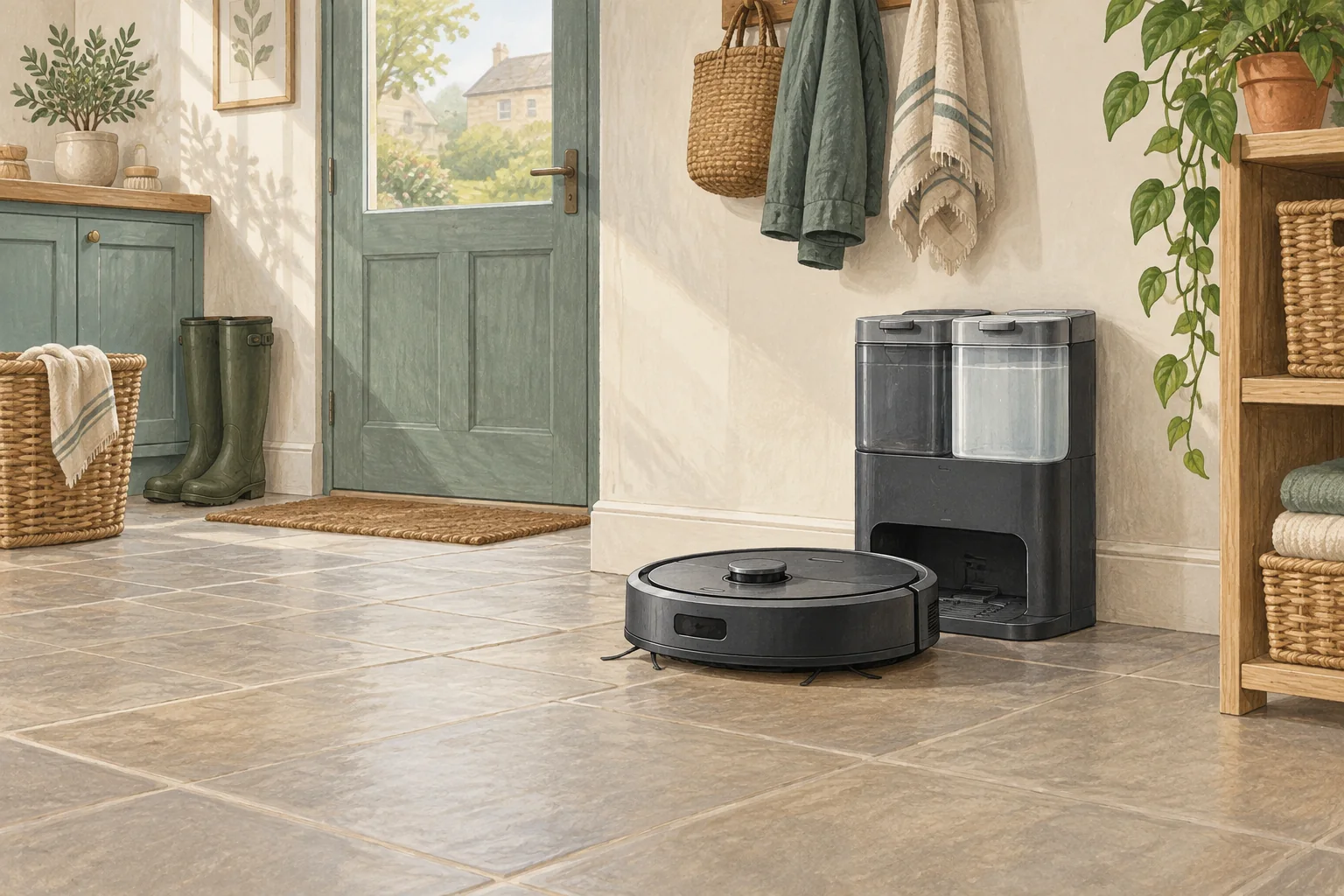
A dock's width, depth and height describe only the object. Installation clearance, lid opening and tank removal can determine whether it is convenient to use.
Table of Contents
A practical checklist
- Mark the footprint on the floor with a removable guide.
- Measure vertical space for lifting tanks and opening covers.
- Check the approach and your own standing space for maintenance.
What this looks like at home
A shelf 5 cm above a dock may make its water tanks impossible to remove even when the station fits beneath it.
Allow space for the work you do at the station
| Check | What matters |
|---|---|
| Robot approach | Use the installation clearances for the exact station. |
| Human access | Allow tank, tray, cover and bag removal. |
| Floor and power | Choose a suitable dry, stable location near an appropriate socket. |
A mistake to avoid
Do not use bare product dimensions as the complete installation allowance.
Relevant models to compare
Roborock Saros 10
A premium option whose retracting LiDAR can help it reach beneath lower furniture.
Check Roborock Saros 10 on Amazon UK. Confirm the selected UK variant, seller, contents and current price.
Eufy Omni C20
A relatively low-profile robot with an automatic mop-care dock.
Check Eufy Omni C20 on Amazon UK. Confirm the selected UK variant, seller, contents and current price.
Related guidance
- Robot Vacuum Charging Station Placement: The Ultimate UK Guide
- Robot Vacuum Maintenance Tips UK: Keep Your Cleaner Running Smoothly
Sources and scope
Checked on 9 September 2026. Manufacturer instructions apply to the models they name; use your own exact manual for button sequences, removable parts and cleaning permissions. Product specifications are advertised claims. Examples illustrate decisions and are not hands-on test results.