
Table of Contents
Introduction: The Evolution of Robot Vacuum Navigation
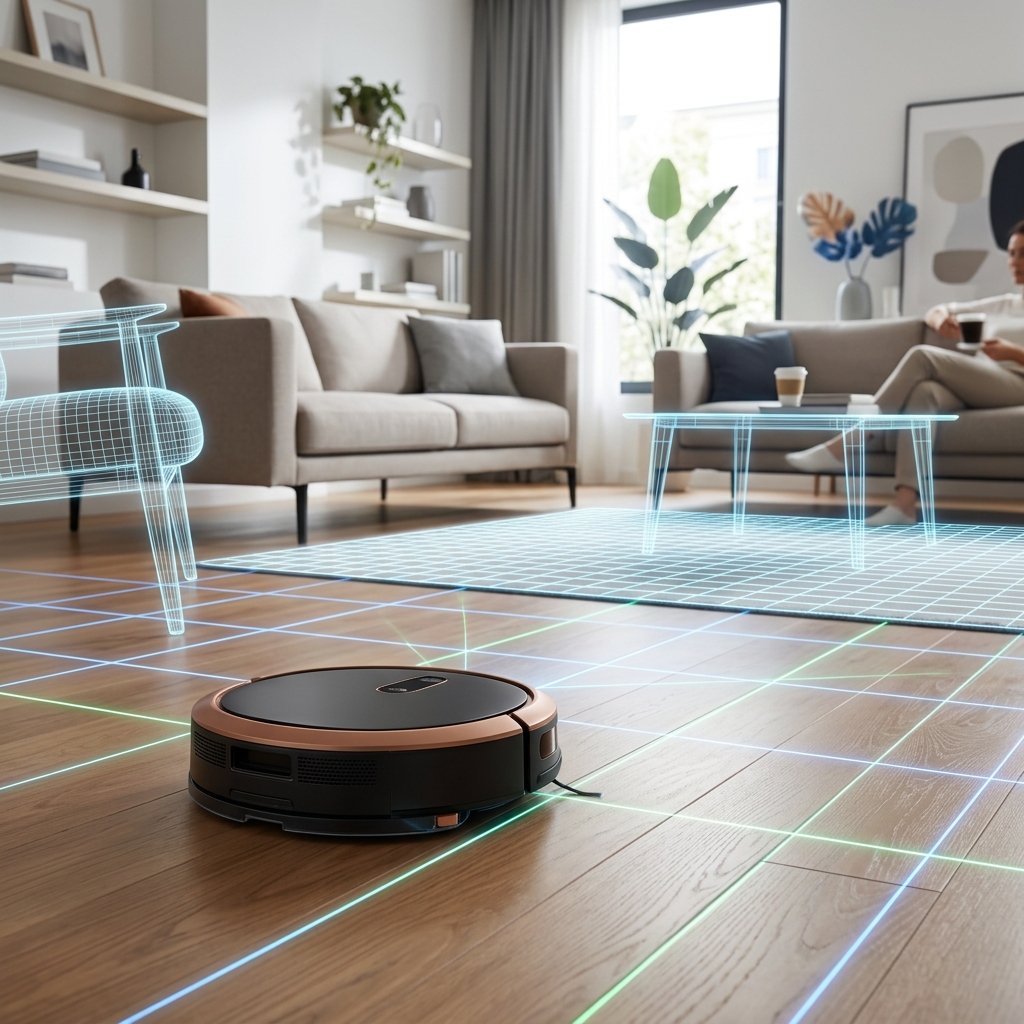
Robot vacuum cleaners have come a long way since their early iterations. Initially, they relied on simple, almost comical, ‘bump-and-go’ methods. These early models bounced around a room randomly, hoping to cover the floor. Today, in 2026, robot vacuum navigation is a highly sophisticated field, powered by technologies like LiDAR, visual SLAM, and artificial intelligence. This evolution has dramatically improved cleaning efficiency, reduced user intervention, and allowed for features like targeted spot cleaning and virtual boundaries. The shift from chaotic wandering to intelligent mapping and cleaning represents a significant leap in home robotics.
Bump-and-Go: The Simplest Navigation Method
The ‘bump-and-go’ method is the most basic form of robot vacuum navigation. As the name suggests, the vacuum simply moves forward until it encounters an obstacle, then changes direction. It lacks any form of mapping or memory, meaning it repeatedly covers the same areas while missing others. While largely superseded by more advanced systems, bump-and-go is still found in some of the most budget-friendly robot vacuums.
Effectiveness: Limited, best suited for small, uncluttered spaces.
Target Use Cases: Very small apartments, quick touch-ups in simple layouts.
Typical Price Range: £100 – £200
Infrared (IR) Navigation: A Step Up in Accuracy
Infrared (IR) navigation builds upon the bump-and-go system by adding sensors that detect obstacles *before* the vacuum physically collides with them. These sensors emit IR light and measure the reflected signal to determine the distance to objects. This allows the robot to slow down or change direction before impact.
Advantages: More efficient than bump-and-go, prevents furniture damage.
Disadvantages: Can struggle with dark-coloured objects (as they absorb IR light), limited mapping capabilities.
Typical Price Range: £200 – £400
Gyroscope Navigation: Building a Basic Map
Gyroscope navigation uses sensors to track the robot’s movement and orientation, allowing it to build a very rudimentary map of the cleaning area. It’s a significant step up from IR, as the robot can remember where it has been and attempt to clean in a more systematic pattern. However, gyroscopes are prone to drift over time, leading to inaccuracies in the map. This means the robot may occasionally deviate from its planned path or miss spots.
Accuracy Limitations: Prone to drift, especially over larger areas.
Improvements over IR: More systematic cleaning pattern, basic memory of cleaned areas.
Typical Price Range: £300 – £500
Visual Simultaneous Localization and Mapping (vSLAM): Seeing the World
Visual Simultaneous Localization and Mapping (vSLAM) utilizes a camera (or multiple cameras) to ‘see’ the environment and create a visual map. The robot uses computer vision algorithms to identify features in the room – furniture, walls, doorways – and uses these features to determine its position and build a map simultaneously.
Strengths: Can recognize objects, avoid obstacles effectively, relatively affordable.
Weaknesses: Performance is significantly impacted by low-light conditions. Requires sufficient visual features in the room.
Typical Price Range: £500 – £900
LiDAR (Light Detection and Ranging): The Gold Standard in 2026
LiDAR (Light Detection and Ranging) is currently considered the most advanced and accurate robot vacuum navigation technology in 2026. It works by emitting laser beams and measuring the time it takes for them to return after bouncing off objects. This creates a highly detailed 3D map of the environment.
How it Works: Laser beams map the room with precision.
Accuracy: Extremely accurate, even in dark conditions.
Cleaning Efficiency: Enables efficient, systematic cleaning patterns.
Affordability in 2026: While previously a premium feature, LiDAR technology has become increasingly affordable, appearing in more mid-range models.
Typical Price Range: £700 – £1600
AI-Powered Navigation & Object Recognition: Smarter Cleaning
The integration of Artificial Intelligence (AI) is taking robot vacuum navigation to the next level. AI-powered robots can not only map the environment but also *recognize* objects within it. This includes identifying cables, pet waste (a particularly important feature for pet owners!), shoes, and other common household items.
Dynamic Obstacle Avoidance: AI allows the robot to navigate around dynamic obstacles – people, pets, moving objects – in real-time.
Learning Cleaning Preferences: Some models can learn your cleaning preferences over time, adjusting their cleaning routes and schedules accordingly.
Benefits of AI: Reduced cleaning interruptions, improved cleaning efficiency, and greater convenience.
Comparing Navigation Technologies: Which is Best for You?
| Navigation Method | Pros | Cons | Price Range (£) | Ideal Home Type |
|---|---|---|---|---|
| Bump-and-Go | Very affordable, simple | Inefficient, random cleaning, poor obstacle avoidance | 100-200 | Very small, uncluttered apartments |
| Infrared (IR) | Improved obstacle avoidance, affordable | Struggles with dark colours, limited mapping | 200-400 | Small apartments, simple layouts |
| Gyroscope | Systematic cleaning pattern, basic memory | Prone to drift, inaccurate maps | 300-500 | Medium-sized homes with simple layouts |
| vSLAM | Object recognition, good obstacle avoidance, affordable | Poor performance in low light | 500-900 | Homes with good lighting, varied furniture |
| LiDAR | Highly accurate, works in dark, efficient cleaning | More expensive (though prices are falling) | 700-1600 | All home types, especially larger or complex layouts |
Future Trends in Robot Vacuum Navigation (2026 & Beyond)
The future of robot vacuum navigation is exciting. We can expect to see:
- Improved AI: More sophisticated object recognition, including the ability to identify different types of messes (e.g., spills, crumbs).
- Multi-Floor Mapping: Robots that can seamlessly navigate and store maps of multiple floors in a home.
- More Sophisticated Object Recognition: Identifying and responding to more nuanced objects and situations.
- Smart Home Integration: Seamless integration with other smart home devices and ecosystems, allowing for voice control and automated cleaning schedules.
- Advanced Dustbin Management: More automated emptying stations with larger capacity and advanced filtration systems.
Conclusion: Choosing the Right Navigation for Your Needs
The best robot vacuum navigation system for you depends on your budget, home size, and specific needs. If you have a small, uncluttered apartment and are on a tight budget, a bump-and-go or IR-equipped model might suffice. For larger homes or those with complex layouts, LiDAR-based navigation is the gold standard, offering the most accurate and efficient cleaning.
Our Top Pick: For overall performance and features in 2026, the Roborock S8 Pro Ultra (£1599.0) offers a fantastic balance of LiDAR navigation, AI-powered object recognition, and convenient features like automatic mop cleaning and emptying. However, the iRobot Roomba j9+ (£1299.99) is a strong contender for homes with pets due to its exceptional pet waste avoidance. The Ecovacs Deebot X2 Omni (£1449.0) is also worth considering for its innovative features. For a more affordable option, the Shark AI Ultra Robot Vacuum (£799.99) and Dreame L20s Ultra (£1199.0) both offer excellent value.
FAQ
Q: Is LiDAR navigation really worth the extra cost?
A: For larger homes or those with complex layouts, absolutely. The increased accuracy and efficiency of LiDAR navigation can save you significant time and effort. However, if you have a small, simple space, other navigation methods may be sufficient.
Q: How well do robot vacuums handle pet hair?
A: Many modern robot vacuums, particularly those with strong suction and tangle-free brushrolls, are very effective at handling pet hair. Models with AI-powered object recognition can also avoid pet waste, which is a major benefit for pet owners.
Q: Can robot vacuums climb over thresholds?
A: Most robot vacuums can handle thresholds up to a certain height (typically around 1-2cm). However, higher thresholds may require a ramp or other modification.
Q: What is “ReactiveAI” or “AIVI”?
A: These are brand-specific names for AI-powered navigation and object recognition systems. ReactiveAI (Roborock) and AIVI (Ecovacs) both utilize cameras and algorithms to identify and avoid obstacles, learn cleaning preferences, and improve cleaning efficiency.
Q: How often do I need to empty the dustbin on a robot vacuum?
A: This depends on the size of your home, the amount of dirt and debris, and the capacity of the dustbin. Some models come with self-emptying docks that can hold weeks’ worth of debris, while others require more frequent emptying.