
Affiliate disclosure: this article contains paid links. As an Amazon Associate I earn from qualifying purchases.
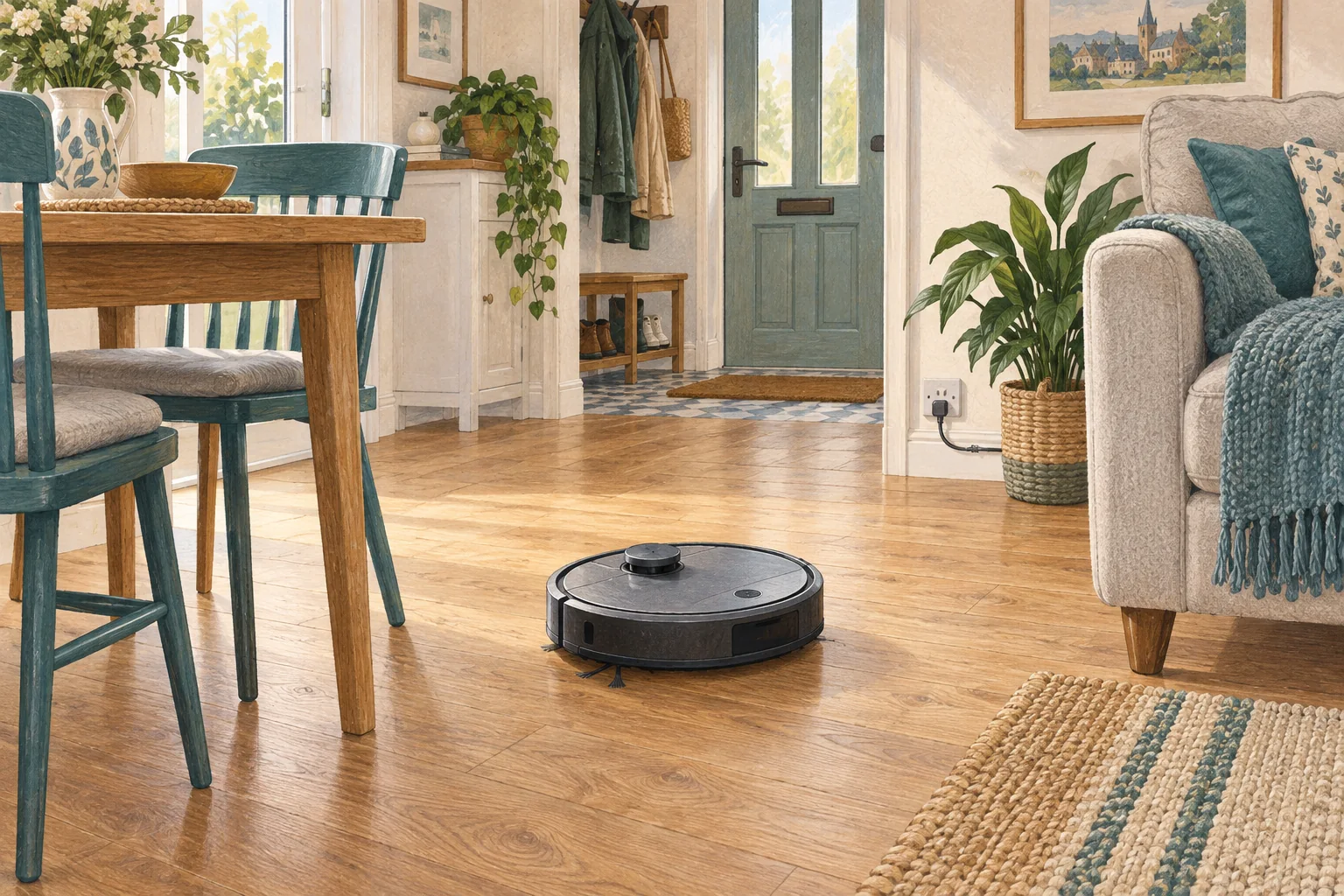
A pedestal can create a sloped or overhanging obstacle unlike four ordinary legs. Watch the robot's approach and escape path rather than judging the table from above.
Table of Contents
A practical checklist
- Check the base height, slope and space below the tabletop supports.
- Remove chairs for the first supervised zone clean.
- Exclude a base that repeatedly strands the robot and clean that area manually.
What this looks like at home
A broad polished metal foot may be detected late or climbed partway before the robot becomes stuck.
Make the route predictable
| Check | What matters |
|---|---|
| Floor-level objects | Lift leads, strings and loose fabric. |
| Narrow gaps | Check entry, turning and escape space. |
| Protected areas | Use suitable boundaries around hazards. |
A mistake to avoid
No obstacle-recognition system guarantees successful handling of every furniture shape.
Relevant models to compare
Eufy X10 Pro Omni
A mixed-floor option combining spinning mops, automatic dock care and camera-assisted obstacle recognition.
Check Eufy X10 Pro Omni on Amazon UK. Confirm the selected UK variant, seller, contents and current price.
Roborock QV35S
An automatic mop-care system with app-adjustable routines and structured-light obstacle detection.
Check Roborock QV35S on Amazon UK. Confirm the selected UK variant, seller, contents and current price.
Related guidance
- Robot Vacuum Stuck? A Comprehensive Troubleshooting Guide
- Robot Vacuum Maintenance Tips UK: Keep Your Cleaner Running Smoothly
Sources and scope
Checked on 9 September 2026. Manufacturer instructions apply to the models they name; use your own exact manual for button sequences, removable parts and cleaning permissions. Product specifications are advertised claims. Examples illustrate decisions and are not hands-on test results.