
Affiliate disclosure: this article contains paid links. As an Amazon Associate I earn from qualifying purchases.
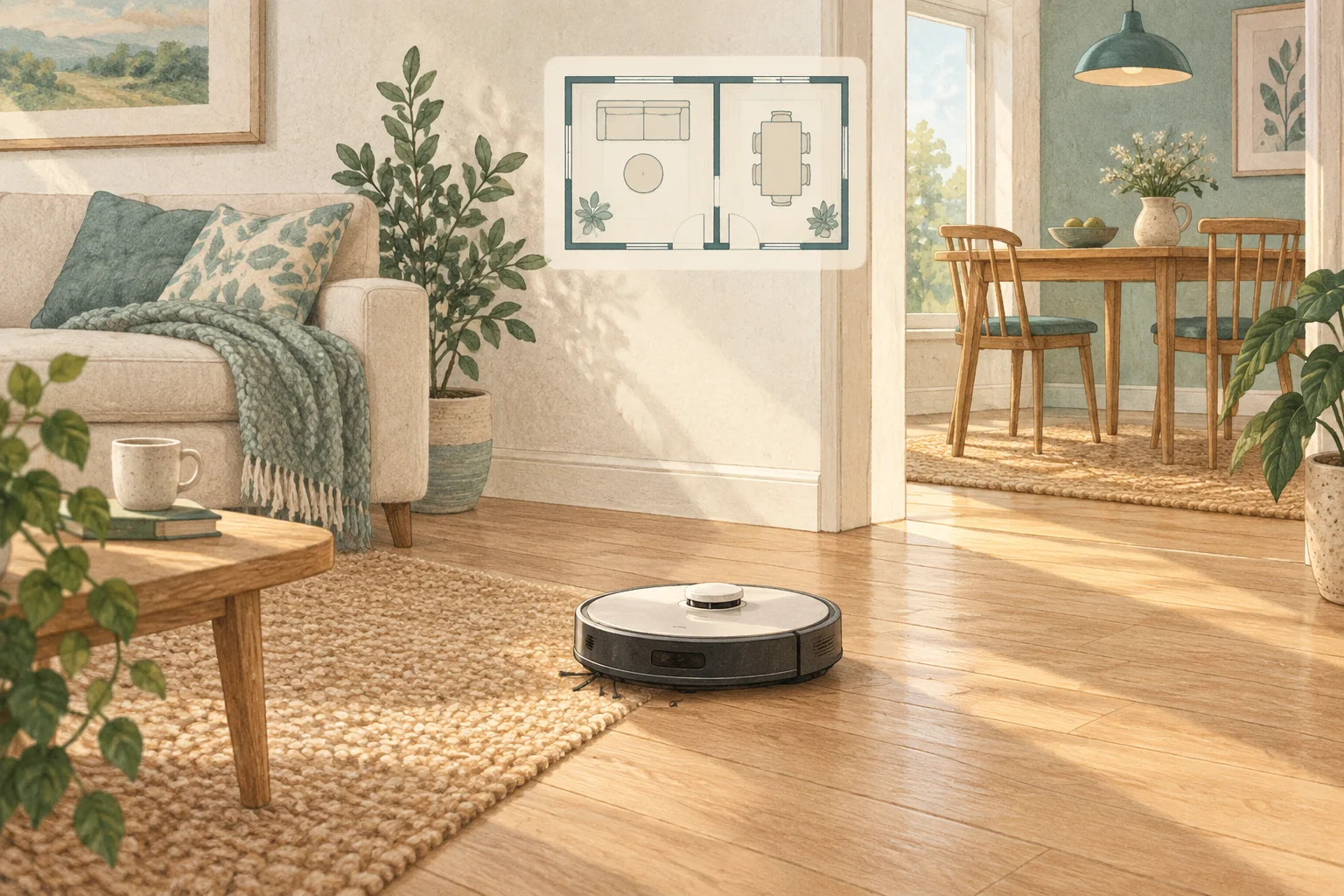
Sliding doors avoid a swinging-door obstacle, but low mirrored panels and floor tracks can still affect the robot. Check both navigation and physical access.
Table of Contents
A practical checklist
- Inspect the track for loose grit and raised edges.
- Watch whether low mirrors create false mapped space.
- Keep hanging clothes and stored straps clear of the route beneath open doors.
What this looks like at home
A wardrobe door left partly open can expose a new narrow gap that was absent during the mapping run.
Give the robot a consistent starting point
| Check | What matters |
|---|---|
| Starting point | Use the model’s recommended localisation procedure. |
| Selected map | Confirm the correct floor and room selection. |
| Physical route | Check doors, furniture and the return to the dock. |
A mistake to avoid
Do not modify or cover the robot's sensors to solve a mirror problem.
Relevant models to compare
Eufy Omni C20
A relatively low-profile robot with an automatic mop-care dock.
Check Eufy Omni C20 on Amazon UK. Confirm the selected UK variant, seller, contents and current price.
Roborock Saros 10
A premium option whose retracting LiDAR can help it reach beneath lower furniture.
Check Roborock Saros 10 on Amazon UK. Confirm the selected UK variant, seller, contents and current price.
Related guidance
- How to Map Your Home for a Robot Vacuum: A 2026 Guide
- Robot Vacuum Maintenance Tips UK: Keep Your Cleaner Running Smoothly
Sources and scope
Checked on 9 September 2026. Manufacturer instructions apply to the models they name; use your own exact manual for button sequences, removable parts and cleaning permissions. Product specifications are advertised claims. Examples illustrate decisions and are not hands-on test results.