
Affiliate disclosure: this article contains paid links. As an Amazon Associate I earn from qualifying purchases.
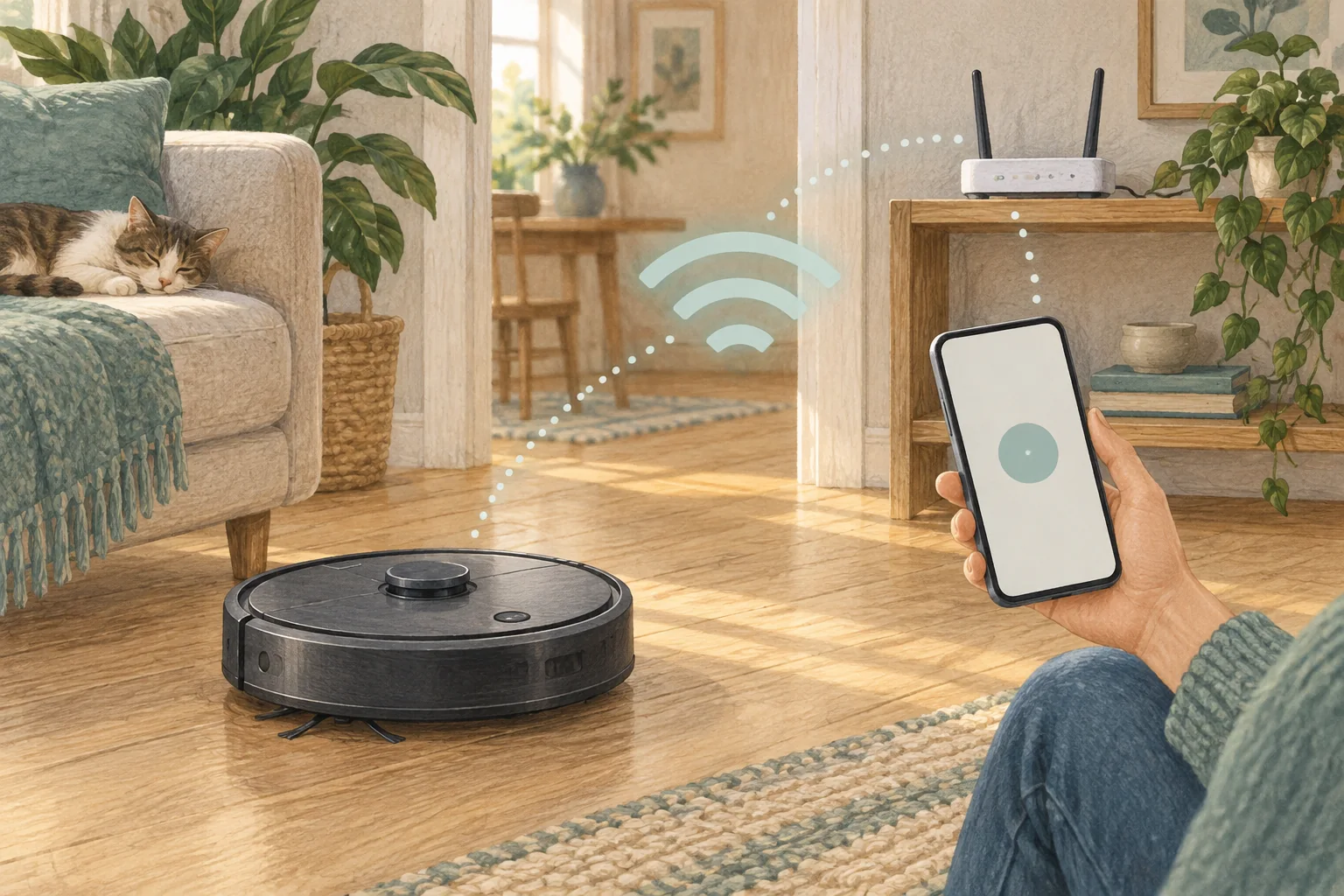
Structured-light sensing and RGB cameras collect different information about nearby obstacles. The practical choice involves object handling and privacy, with model-specific implementation doing much of the work.
Table of Contents
A practical checklist
- Read the exact sensor list rather than the phrase AI navigation alone.
- Check whether image viewing or recording features exist and how they are controlled.
- Evaluate the floor-preparation routine you are willing to maintain.
What this looks like at home
A robot using structured light for nearby shapes may not offer the same visual features as a model with an RGB camera.
Separate sensors, local control and cloud features
| Check | What matters |
|---|---|
| Sensors | Verify the full specification and optional visual features. |
| Local control | Identify what works on physical buttons. |
| Connected features | Check accounts, sharing and internet requirements. |
A mistake to avoid
Do not infer zero data collection simply because a product does not advertise a camera feed.
Relevant models to compare
Roborock QV35S
An automatic mop-care system with app-adjustable routines and structured-light obstacle detection.
Check Roborock QV35S on Amazon UK. Confirm the selected UK variant, seller, contents and current price.
Eufy X10 Pro Omni
A mixed-floor option combining spinning mops, automatic dock care and camera-assisted obstacle recognition.
Check Eufy X10 Pro Omni on Amazon UK. Confirm the selected UK variant, seller, contents and current price.
Related guidance
- Master Your Robot Vacuum: A Complete Guide to Using the App
- Robot Vacuum Maintenance Tips UK: Keep Your Cleaner Running Smoothly
Sources and scope
Checked on 9 September 2026. Manufacturer instructions apply to the models they name; use your own exact manual for button sequences, removable parts and cleaning permissions. Product specifications are advertised claims. Examples illustrate decisions and are not hands-on test results.