
Affiliate disclosure: this article contains paid links. As an Amazon Associate I earn from qualifying purchases.
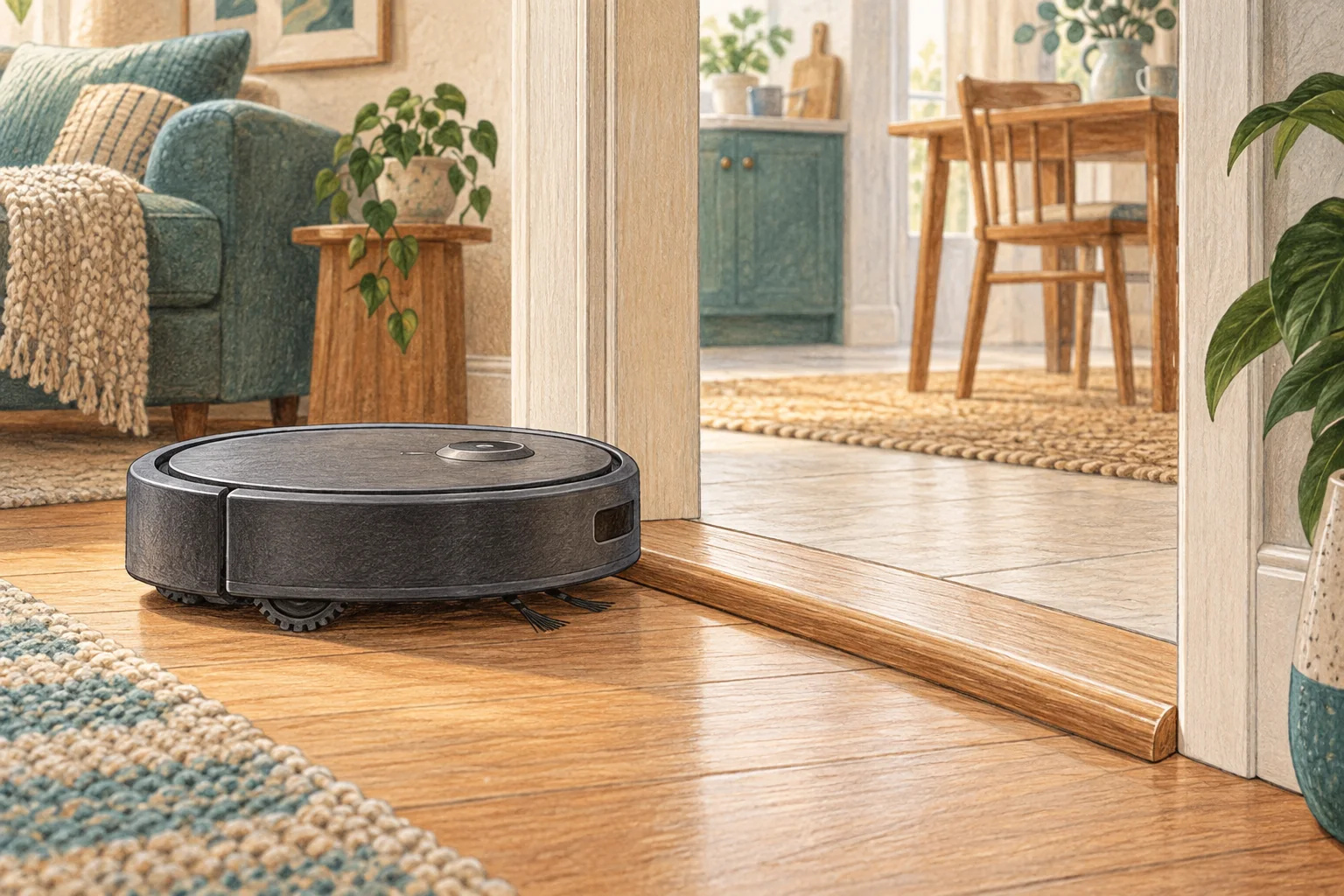
Uneven tiles create two separate challenges: getting across the surface and maintaining useful mop contact. A high suction number does not resolve either automatically.
Table of Contents
A practical checklist
- Check raised edges and deep grout lines for snagging points.
- Watch a supervised vacuum-only pass before introducing water.
- Prefer accessible brush and wheel maintenance if grit collects in joints.
What this looks like at home
A rustic kitchen tile with a pronounced edge can interrupt a spinning pad even when the wheels cross it.
Measure the profile in both directions
| Check | What matters |
|---|---|
| Rise | Measure from each side of the doorway. |
| Shape | Note sharp edges, slopes and narrow crests. |
| Return | Confirm the robot can get back to its charger. |
A mistake to avoid
Avoid assuming a threshold-height claim guarantees smooth travel across every uneven floor.
Relevant models to compare
Dreame L40s Pro Ultra
A mixed-floor system with detachable mops and dual-brush hair management.
Check Dreame L40s Pro Ultra on Amazon UK. Confirm the selected UK variant, seller, contents and current price.
Roborock Q7 M5
A vacuum with occasional damp wiping and app-controlled water delivery.
Check Roborock Q7 M5 on Amazon UK. Confirm the selected UK variant, seller, contents and current price.
Related guidance
- Robot Vacuum Stuck? A Comprehensive Troubleshooting Guide
- Robot Vacuum Maintenance Tips UK: Keep Your Cleaner Running Smoothly
Sources and scope
Checked on 9 September 2026. Manufacturer instructions apply to the models they name; use your own exact manual for button sequences, removable parts and cleaning permissions. Product specifications are advertised claims. Examples illustrate decisions and are not hands-on test results.